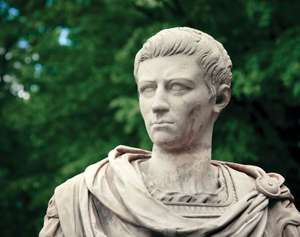
Lord Byron was once famously described as “mad, bad, and dangerous to know”. However, nearly two thousand years earlier, the bar for mad, bad and dangerous was set very high. I am talking of course about Caligula, whose reign over the Roman Empire was brief, but unforgettable, and continues to capture the hearts of historians, novelists and psychologists even today.
Born Gaius Caesar Germanicus, Caligula earned his nickname, which translates to ‘Little Boots’ for the military boots he wore as a child. See, Caligula was born the son of Germanicus, Rome’s foremost general, popular with soldiers and citizens alike. So popular, it seemed, that his uncle – the Roman Emperor Tiberius, no less – was concerned that Germanicus might present a threat to his rule.
Tiberius was austere, serious, and merciless. He was in many ways the ideal ruler for Rome, and over his reign the Empire enjoyed peace and prosperity. However he was notorious for blatant murders of his political enemies, and while his agents scoured Rome for traces of treason, Rome’s citizens lived in fear of their emperor.
Once Tiberius had set his eyes on Germanicus, it was clear that he wasn’t going to rest until his entire family was taken down. Germanicus himself was killed when the wife of one of Tiberius’ loyalists – the Governor of Syria, Calpurnius Piso – poisoned him. Whether Tiberius was personally responsible or not will likely never be answered, but it is almost certain he played a part. For a while, Tiberius was content, but when his son died, leaving Germanicus’ three sons the sole heirs to Rome, he renewed his spite. Germanicus’ eldest son was forced into suicide, and his wife exiled, and their second son imprisoned. Both would die a few years later, by starvation.
Caligula escaped this purge by, at the time, staying with his relatives, who retained some political clout in Rome. They shielded the young prince, who was now the obvious heir to Tiberius’ throne, until he was invited to Tiberius’ estate on the island of Capri. Perhaps Tiberius could see that he was better of keeping his enemies close, so he could watch over them. At Capri, Tiberius made Caligula and Caligula’s cousin Gemellus co-heirs to Rome, although there can be no mistaking which of the two held more influence and political ability.
Capri is one of the horrible stories of history that must be told, for better or for worse. Tiberius, who had retired from public life to live on this lavish Mediterranean estate in the Bay of Naples, used Capri in the same way wealthy magnates today do – to live out his fantasies. Just as Escobar famously filled his estate of Hacienda Napoles with wild animals like rhinos and flamingos; so too did Tiberius fill Capri. Except rather than animals, he filled Capri with the sons and daughters of his senators, up-and-comings willing to do anything to get into the emperor’s good books. There, they were treated as pets by the Emperor, dressed in mythical costumes (Tiberius had a fascination with the Greek Mythos), and forced to partake in animalistic sex games across the island, as the elderly Tiberius watched on, with grim enthusiasm. Gemellus and Caligula, it seems likely, were also forced to partake in Tiberius’ sexual power plays.
Caligula knew how to play the political game, and he suffered under Tiberius’ perverted yoke without any complaints. He was willing to do anything – anything – to become Emperor. And so, when Tiberius finally died, alone and hated by his people, Caligula was there ready to take the mantle.
Compared to Tiberius’ austere, antique and vindictive premiership, the sudden introduction of Caligula, the young, charismatic and exciting successor was a delight for the Roman people. As he marched victoriously into Rome, Gemellus being immediately sidelined, Caligula was declared Emperor of Rome. Everyone, none moreso than Caligula, was thrilled.
However, this honeymoon period was not to last. Caligula had initially held great public events, lavishing gifts on the City, but within a few months, he fell gravely ill.
While Caligula lay on his deathbed, the people of Rome were heartbroken. One prominent senator solemnly swore that he would rather the Gods killed him than their beloved emperor. Behind it all, the machinations were being put in motion for the Emperor’s funeral.
Against all the odds, Caligula recovered. And now fully reminded of his own mortality, he entered into a madness, badness and dangerousness even Byron would be scared of. He kicked things off by having Gemellus tracked down by the Praetorian Guard (the Emperor’s personal army), and forced to commit suicide. Upon hearing of the senator who had wished for his own death over Caligula’s, the vicious emperor sought him out and forced him to fulfill his promise, and kill himself.
This was only the beginning. With an insatiable lust for power, Caligula tested just how far he could take things. He made mistresses of his friends’ wives, going so far as to hold feasts with high ranking senators, taking their wife into a different room, raping her, and then returning to the feast as if nothing had happened. Caligula’s own father-in-law, one of his most loyal partisans, was murdered on the Emperor’s whim.
Things weren’t helped by a great betrayal from within his closest allies. On Capri, Caligula had found a close friend – and lover – in Marcus Lepidus. Once Emperor, he married Lepidus to his sister, and had him publicly recognised as his heir. However after his wife died, Lepidus – every bit as lustful and callous as Caligula himself – had begun an affair with both of Caligula’s other sisters. Caligula loved his sisters dearly, and any insult dealt to his sisters was punishable by death. Lepidus betraying his late-wife and deflowering Caligula’s other two sisters? That was not just one but three betrayals against the Emperor. With one clean stroke, Caligula exiled his surviving sisters, and Lepidus was executed. He wasn’t even allowed a funeral.
One man who had been vital in Caligula’s rise to power was the Prefect of the Praetorian Guard – in essence the top general in Rome. This man, Macro, had escorted Caligula to Rome after Tiberius’ death, and had helped bully the Senate into sidelining Gemellus out of Tiberius’ will.
Alas, Macro was not a loyalist. He was merely following his own self-interests, rather than those of Caligula. When the emperor was ill, Macro had sought out friendship with Gemellus, preparing to make him emperor once Caligula’s fever killed him. Obviously, after his recovery, Caligula was not best pleased with Macro. He, too, was forced to commit suicide.
Caligula’s maddest stint was yet to come, though. While a young man, a seer had predicted that Caligula would be as likely to become Emperor as he was to ride a horse across the Bay of Baiae. Remembering this condescension, Caligula decided he would do the obvious thing – and ride a horse across the Bay of Baiae.
Obviously the fatal flaw in this plan was that, as with most bays, Baiae was a body of water. A notorious party town for Rome’s wealthy young – a Roman Ibiza, so to speak – Baiae jutted into the Mediterranean sea, creating a small bay within the Bay of Naples. Caligula demanded the entire Roman navy flock up to the coast. He had them form a line, all the way from Baiae to Puteoli, a wealthy town famous for its snails, glass and concrete. He had these boats covered in dirt, such that they could be considered land, and once satisfied rode his horse across it. Such a stunt was to be remembered in the annals of history – but as a sign of madness, rather than of power.
However it is important to evaluate Caligula’s cleverness. He did not do all of this out of some foolish madness, so out-of-touch with reality he didn’t know how else to act. No- he knew what he was doing. He could see all too clearly that Rome’s entire economy, politics and culture was dependent on the Emperor. Rome’s emperor was, without a doubt, the most powerful man in the world. This grandiose sense of awe that his citizens felt towards him – it was unbreakable. Caligula knew that whatever murders he ordered would be forgiven, because no one would dare risk being the target of the next one. He consistently undermined the Senate – even supposedly threatening to install his horse as a Consul, the highest ranking senator. Everything he did was an act to undermine those close to him, and assert his right as the sole holder of power in Rome.
Caligula even went so far as to convert a wing of his great palace into a brothel, and used it to prostitute the children of senators who had fallen out of favour. This disdain for even the uppermost echelons of Roman society is typical Caligula, but it also shows valuable commentary on the attitudes of the senators. Just as under Tiberius, senators had been prepared to prostitute their children at Capri in order to win Tiberius’ favour, now they attempted to get into Caligula’s own good books with the same trick. They failed to understand that Caligula had no respect for such bootlicking. The machinations of senatorial politics didn’t matter to Caligula, but that didn’t stop the senators from trying to win him over all the same, and this came back to bite them as their wives were raped, their daughters prostituted, and their sons executed. Caligula was mad, sure, but he was also very clever. A masterful villain who understood his enemies perfectly.
However, Caligula did have to depend on these social structures he so frequently disrespected to survive. Had the senators done as Caligula did, and used violence and fear to assert their own power, Caligula would have been murdered long before he had the chance to enact his madness. However the Senate followed its own laws, and because of this they failed to gain any control on the Mad Emperor.
Unfortunately for Caligula, there was one order that had relied on violence and fear since its conception. The Praetorian Guard, much like a Roman KGB, answered only to the Emperor, and killed anyone he wished to kill. This senseless ability to kill became Caligula’s downfall.
Cassius Chaerea was a Praetorian soldier with a distinguished record as one of Rome’s greatest commanders. Politically agile, he maintained a sense of respect and admiration from everyone in Rome. Everyone that is, except Caligula. Chaerea was effeminate, with a feminine voice. Anyone who knew of his track record knew well enough that underneath the effeminacy, Chaerea was a force to be reckoned with, but Caligula underestimated the man. He mocked the soldier’s voice, and made him use watch-words while on duty like ‘erection’ and ‘eunuch’. This drove Chaerea over the edge.
It was the final day of the Palatine Games, 41AD, and Caligula sat in the emperor’s box watching a play about a Greek king being murdered by his own people. Nervously, one of Chaerea’s conspirators suggested they go for lunch,and Caligula reluctantly agreed. Caligula was led through the tunnels of the Palatine Hill, where he began to approach Chaerea, who was waiting for him with Macro’s replacement as Prefect of the Praetorian Guard, who was also in on the plot. Chaerea asked Caligula what the day’s watch-word was going to be, presumably expecting some condescending answer like ‘girl’ or ‘prostitute’, but instead, Caligula simply replied, “Jupiter,” and turned away. Chaerea muttered a reply, and as Caligula turned back to look at him, he drew his sword, and struck it fiercely into the back of Caligula’s neck. Caligula was still alive, and cried out in a mad rush of adrenaline, before Chaerea once again struck him, this time in the back. As Caligula squirmed under Chaerea’s blade, the other commanders of the Praetorian Guard drew their swords, and began to mercilessly put an end to the tyrant.
Caligula died a hated man. His wife and daughter were also put to death, as one final insult to the Emperor. His career had been defined by his sustained attacks on the establishment, and brilliant displays of eccentric power. But more than that; he had created in himself a figure whose gruesome evil would be remembered for millennia as the cruellest man who ever lived.
 The History Book