Russia is a vast and unique country, and its history is no exception. When you think of Russian history, perhaps you think of Peter the Great, who won the Great Northern War and founded St Petersburg; or perhaps of Stalin and the political purges of the Soviet Union; or maybe even Ivan the Terrible, the first Tsar of Russia.
I could go on- Russia has spawned many eclectic historical figures. However, there are some who were just as fundamental to the development of Russia whose names now are unfortunately left as mere footnotes in history. The names to which I refer – those of the Kievan Rus.
The Kievan Rus were, loosely speaking, the first truly Russian state. Headed by the Rurikid dynasty, which was founded in the 9th Century and survived until 1612, the Rus were a federation of loosely connected principalities, who all owed their allegiance to – you guessed it – Kiev.
The Principality of Kiev was headed by the Grand Prince, and it was he who ruled over the other Princes. The other states (Novgorod, Chernigov, Smolensk, Rostov-Suzdal, Polotsk, Ryazan, Pereyaslavl, Halych, and Volya) were led by Princes, who were all close relatives of the Grand Prince.
Perhaps it is important I explain how succession worked in the Rus, since it was a succession rule completely alien to anything we would understand today. The eldest male of the family took the title Grand Prince of Kiev, and his brother, the second oldest, would take the title Prince of Novgorod – the second richest principality. Then each of the brothers in turn would become the other princes, such that the youngest brother had the weakest territory.
This is fairly typical of a medieval monarchy, but where it differs is that when the Grand Prince died (often in suspicious circumstances), his son would not inherit Kiev. Instead, the Prince of Novgorod would move up the career ladder, and then the third brother would inherit Novgorod, and so on. The eldest son of the former Grand Prince would then move up into the now-vacant seat of the youngest son.
This was called the ‘rota’ system, and it was important in keeping the Rurikid family tied as one unit. It meant that when one particularly successful Grand Prince married and had children, the brothers would not become alienated from power after the Grand Prince’s death. Thus, the family, ideally, would not splinter into factions.
Unfortunately, the key word in that sentence is ‘ideally’. Since each son’s children would eventually find a rung on the principality-career ladder, every generation the brood got bigger and bigger, as the amount of titles available stayed the same, so that younger sons would find themselves without any titles whatsoever. It meant that eventually, the now-massive family broke apart into several cadet branches. These branches often took turns in power, fighting internal wars against each other every few generations. It was this internal fighting that left the Rurikids especially vulnerable to the Mongol invasion in the 13th Century, and ended the reign of the Rus.
Anyway, enough of abstract talk, let’s cover some historical fact.
In the West, we know of Vikings as coastal raiders who ravaged British, French and Dutch shorelines, hoarding treasure and burning monasteries, but we often forget that they raided just as much – if not more – in the East. However, while to travel from Scandinavia to France and Britain, the Vikings had to go by sea, to travel east they were able to travel by land. This meant it was easy for Vikings to have larger and more frequent raids, and to settle newly conquered land. In the east, the name for the Vikings were the ‘Varangians’.
One especially vicious Varangian was a man called Rurik. Rurik, with his younger brothers as his lieutenants, was chieftain of a tribe called the Rus. With this band of warriors, he travelled eastwards, conquering all in his path. Setting up the Principality of Novgorod, he declared himself its prince, and delegated his brothers smaller principalities he had conquered all around his own.
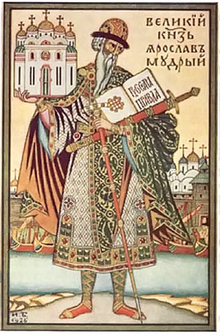
Novgorod remained the Rus’ capital until the supremacy of Yaroslav (alternative spelling, Jarisleif) the Wise. Yaroslav was one of the younger children of the Grand Prince of the time, Vladimir the Great, and thus it seemed rather unlikely he would have much stake in his kingdom. However, due presumably to the wisdom implied by his name, he proved himself a force to be reckoned with. Following his father’s death, his eldest brother Svyatopolk (later known as the Accursed), claimed Kiev. Svyatopolk knew the risks of having younger brothers in Medieval Europe, and since was not prepared to risk having himself dethroned, he dispatched murderers to solve the problem and make him an only child.
These other brothers included Boris, who was popular with the people, pious, and a great military commander; Gleb, who was a loyal supporter of both his brothers; Sviatoslav; and Yaroslav. As his father lay dying, Svyatopolk had summoned Gleb to Kiev, and after he arrived, Svyatopolk had his cook cut Gleb’s throat.
Simultaneously, hired Varangian hands snuck into Boris’ tent, and stabbed him and his manservant to death. As they carried him out, they discovered he was still breathing, and promptly finished the job a second time. Sviatoslav’s death is not so well recorded, but he too fell, at Svyatopolk’s hand. It was this blood-crime that won him the nickname ‘the Accursed’.
Yaroslav, however, survived, and upon learning of his brothers’ deaths he raised his own army, and had Svyatopolk forced into exile. After three years of vicious fighting between the two, Svyatopolk abruptly died on campaign, leaving Yaroslav the sole Rurikid heir.
As Grand Prince, Yaroslav set about creating a new golden age for the Rus. Ruling from as north as Estonia all the way down to the Crimea, Yaroslav was the powerhouse of Europe, and was considered a fierce enemy even by the Byzantine empire. Cultivating foreign relations with expertly wisdom, Yaroslav married his daughter to the not-yet-king-of-Norway Harald Hardrada, who at the time was a fierce mercenary and warlord, with his own private army and who had singlehandedly deposed and blinded the Byzantine Emperor Michael V. Yaroslav himself had also long been an ally of Sweden, securing his northern border, and a marriage-alliance with Edward the Exile, an exiled Prince of England. His grandson even married the daughter of Harold Godwinson, although this is disputed since there’s no contemporary Russian evidence for it.
Yaroslav’s greatest achievement, perhaps, was installing the ‘rota system’ we discussed earlier. Although his sons, all very ambitious, immediately set about trying to dismantle it. He also led Russia into its wealthiest era yet, with a strong military – although since his foreign relations were so reliable, his only enemy was the Byzantine Empire. Yaroslav was also well educated, and set about installing a firm code of law within his federation of states, as well as protecting the Rus in the southern regions from nearby warring tribes by building fierce forts that would survive until the Mongol invasion. He even appointed a Slavic monk to the Bishopric of Kiev, in an attempt to rival Constantinople’s monopoly on Orthodox Christianity.
After Yaroslav, the Rus’ rule became less and less secure, until finally the Mongolian Golden Horde overwhelmed it and installed Rurikids as mere client kings. The Rurikids delicately balanced the tightrope of power until their eventual extinction in the early 17th Century. Though their time in power is often overlooked, it is the fundamental origin of Russia as a state, and created a sense of identity that still stands strong from St Petersburg to the Crimea. Even now, Russia lives on as a federation of different regions, as did the USSR as a federation of Soviets. And so, the legacy of the Rus remains, even in Russia’s name, and will remain so long as Russia, in one form or another, exists.
 The History Book