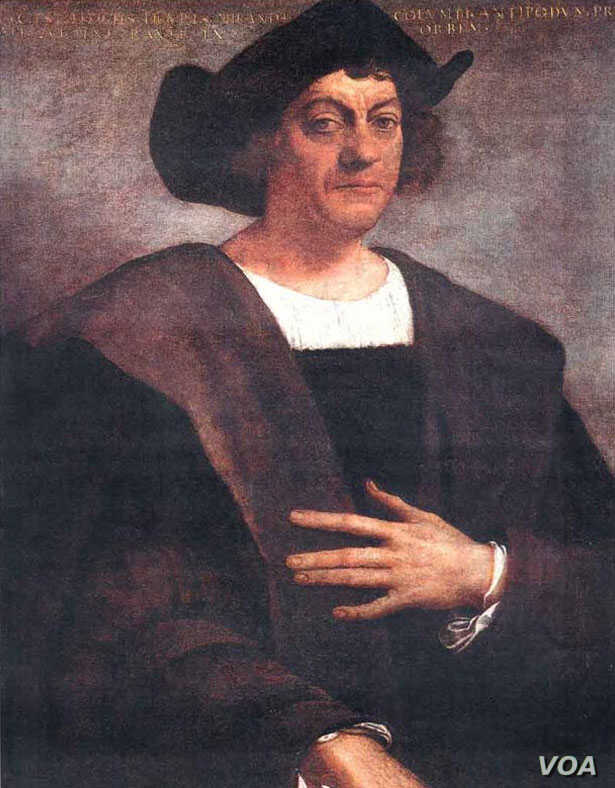
Everyone knows of Christopher Columbus – the man who ‘discovered’ America. The man who caused Europe’s power to increase dramatically, allowing it to conquer the globe and who also caused the deaths of millions of people, and the suffering of millions more. His journey is well documented and his life, seemingly well known. However, many people reduce his intentions for finding the East purely one of Religious hatred of Muslims. But they go much deeper than this, far greater than many really know. In this essay, I shall explain such motivations.
In 1453, the final beacon of the Roman Empire, Constantinople, fell to the Ottoman Empire. The latter saw themselves as the direct successors (as opposed to the continuation of) their predecessor. It was said that news of the conquest led to grown men falling to their knees crying in the streets of Renaissance Rome. However, perhaps the two countries most affected by this were Spain and Portugal. Both of which were, by most accounts, provincial backwaters, devastated by centuries of ‘Reconquista’. The whole affair created a society of religious intolerance, and a particular hatred of Islam. Following the 1469 unification of Castile and Aragon, the political unit of ‘Spain’ was created for the first time.
For centuries, Europe had been a hotbed for Orient trading. The Silk Roads continually brought goods from the East into the West, who so desperately desired it. The Mongol Empire brought greater stability and safety for the trade routes, and from the thirteenth century, trade across Eurasia blossomed even further. During the Empire’s rise, many Christians (still very much within the Crusading spirit) hoped to use this ridiculously powerful army to their advantage. In their eyes, they could not only convert the Mongols to Christianity, but also bring them onside and finally tip the balance to their favour – and conquer the Holy Land. This had mixed success. Mongol’s religious policy was pragmatic and advantageous. Leader’s, recognising Europe, the Middle East and North Africa’s fervent ferocity for religion, simply used it as another tool for diplomacy and conquest. Making promises to convert in order to either make friends or create vassal states – it was a perfect scheme and fooled both Christians and Muslims alike.
However to say that the Mongol’s merely used this to hoodwink Christians and Muslims alike is not entirely accurate. As the rubber band began to stretch, and further conquest threatened to snap it back to the centre, the Mongol’s found themselves in need of making friends. This became especially true of the Golden Horde and Ilkhanate after the Empire split into four. As such, evidence seems to suggest that communique between Europe (France and England especially) was high, and cooperation existed. In fact, the Mongol’s did indeed fight the “Saracen’s” in order to help the Christians. In one of the most interesting battles in history, the Ilkhanate faced off against the freshly victorious Mamluk’s.
What does all of this have to do with European conquest? Very little, apart from the fact it fostered a legacy – that not only were the Mongol’s open to Christianity, they were willing to help in the reconquest of the Holy Land. All of these idea’s happened to fall into the mind of one particular man: Christopher Columbus.
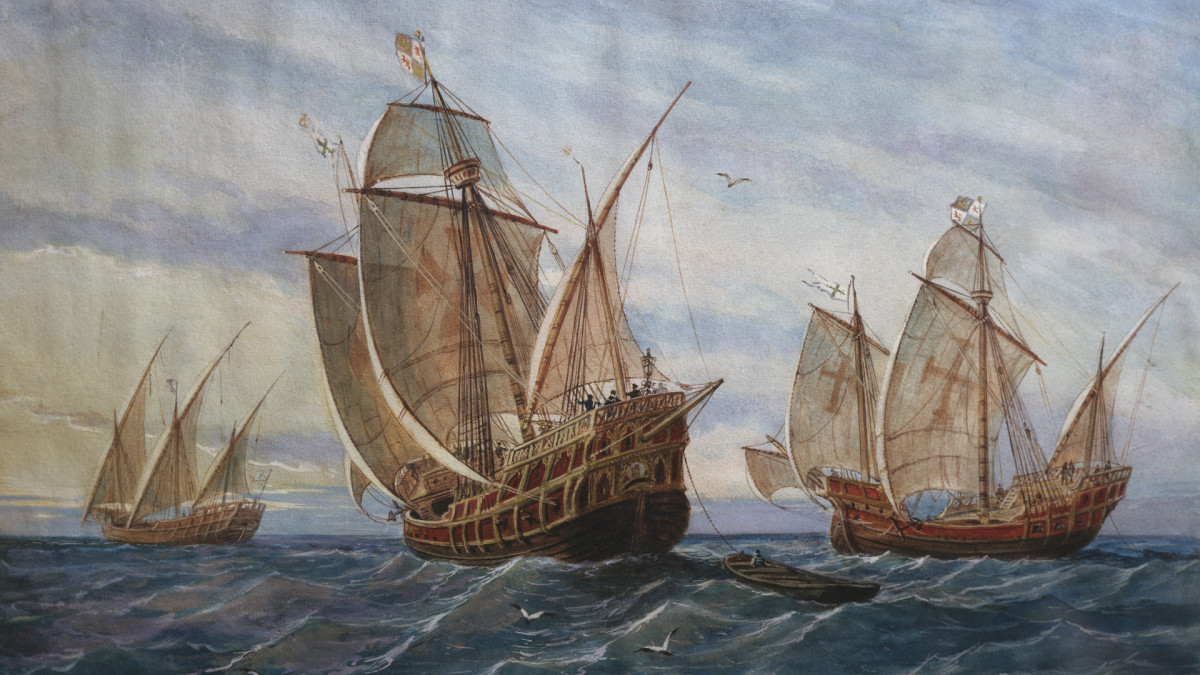
Originally motivated by finding a new sea-route to Asia. Not, like many people think, to find new trade routes; but to actually find the ‘Great Khan’ and convert him to Christianity, and then convince him to do what the weaker Ilkhanate couldn’t – take the Holy Land. Columbus managed to convince Ferdinand and Isabella of Spain that his cause was a worthy one. – Liberate the Holy Land, and restore Byzantium. While both were very much Anti-Muslim, they were unwilling to put a great deal of money and support behind such a risky venture. And so he received just those three ships – the Santa Maria, the Nina and the Pinta.
What happened next was beyond anyone’s wildest imaginations and expectations and transformed the fortune’s of Europe overnight. But these were not Columbus’ intentions. Within his diaries, it can be seen that Columbus entirely thought he’d discovered America – describing natives he’d found within the Caribbean of the same complexion as Indians, and as such – he’d surely discovered the West of India.
But he had not discovered Asia. He’d discovered America. And so the dream of liberating the Holy Land died with that voyage. The letter he’d written, addressed to the Great Khan (he’d actually left it blank, hoping that he could write it in upon discovering the name of whoever was now the Great Khan, which he didn’t know), would never be delivered.
It is here where the final dream of a Christian Holy Land died, and the legacy of the Crusade’s ended. Coinciding with a chapter of European history – The Medieval Era, coming to a close. And a new one – The Early Modern Era beginning.
Christopher Columbus was likely, even by the standards of the time, backward thinking; judging from the fact the size of the earth was pretty common knowledge, and far larger than his estimations. But his importance cannot be understated, even if his motivations were peculiar.
 The History Book