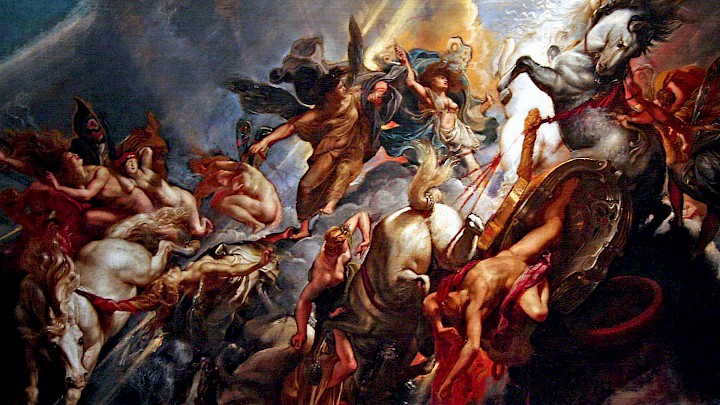
The Greco-Persian Wars 499 – 479
The Ionian Revolt 500 – 499.
In order to accurately explain the Peloponnesian Wars and why they started, it is first important to understand the preceding war, which caused the subject in question. This is the Persian War. The Greco-Persian Wars were a long, bloody conflict between the fledgling Greek city states, and the world’s first superpower: Persia. The Persian Empire was only a young one, after Shahanshah (King of Kings, hereby referred to as “Shah”) Cyrus “The Great” defeated King Astyages of the Median Empire at the Battle of Ecbatana in around 550 (In a strange act, yet not unlike the character of Cyrus, it is said Astyages’ life was spared. Cyrus would later go on to free all the enslaved Jews after conquering the City of Jerusalem, and become the only Non-Jewish prophet in history). Cyrus had spent almost the rest of his life conquering, and building up the Empire, so that it spread from the deserts of Egypt, all the way to the border of India. It was the largest empire to have ever exist, and thoroughly deserves Holland’s title of ‘The first world empire’ (Holland, 2005).
In 546, Cyrus’ forces conquered the Lydian Empire by taking the capital of Sardis. In common Persian fashion, a Satrap was established, which essentially allowed for relatively free rule by the Satrap (Chosen by the Persian Shah), so long as they adhered to Persian hegemony, rules, and paid tribute. Many have come to argue that, due to this, Persia was one of the most liberal empires in history. And while this is the case, the explanation can be attributed not to an exclusive characteristic given to Persian Shah’s exclusively; more a fact that centralisation of governance would have been impossible for the technologies at the time with the size of an Empire like Persia’s. (Persia’s system of governance would be repeated across the Ancient World, including by the Roman Republic and Empire through its use of provinces).
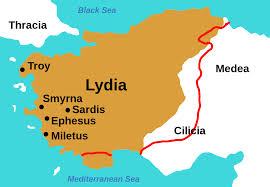
However, the event that began the great domino chain that would lead to the Greco-Persian Wars, was a simple promotion. Under the majority of the Satraps, Cyrus merely had to sponsor an elite native group to help maintain control, as he had done with the Priesthood of Judea. However, in the Greek cities in the Satrapi of Lydia, there was no such group. While there was a native Aristocracy, these were usually divided into factions. Thus, Cyrus and his successors were forced to sponsor Tyrants (At this time, the definition of “tyrant” was a far cry to our current understanding. At the time, the word merely referred to a single man who could control a cities democracy effectively enough that a majority of his supported bills were passed through an assembly. Both Cimon and Pericles of Athens would be classed as “Tyrants”, despite Athens’ world renowned democracy). The revolts were instigated by the tyrant Aristagoras, after be succeeded his predecessor, Histiaeus, who had become one of Shah Darius I’s ‘Royal Table-Companion’ (Holland, 2005).
In 500, exiles from the island of Naxos came to Aristagoras with the request of taking control of the island. The governor accepted, and travelled to Sardis to meet the Satrap of Lydia; Artaphernes who accepted Aristagoras’ proposal of supplying an army in exchange for a share of the spoils (It was commonplace for looting of a captured area to occur at the time).
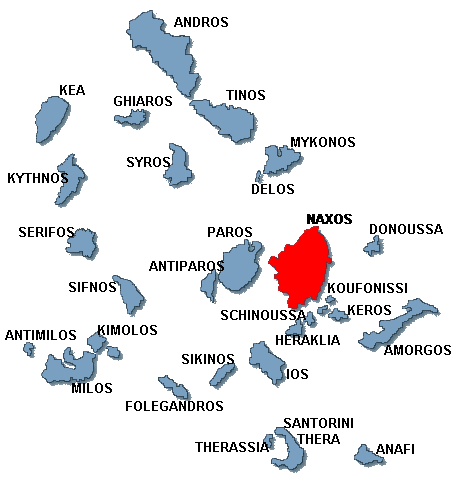
However, Herodotus tells us that Aristagoras fell out with Artaphernes’ chosen general, Megabates. This then caused the latter to send word to the island, to inform them of the invasion. What would have been a quick surprise attack and a probably Persian victory ended in a four month long siege, and an eventual Persian retreat after they ran out of money and supplies. Aristagoras now found himself unable to pay Artaphernes and had fallen out of favour with the Persian Shah. Expecting to be stripped of his position, and possibly ostracised, Aristagoras persuaded the people of Miletus and Ionia into open rebellion, in an act that Holland says was ‘to toss a flame into a kindling box.’ (Holland, 2005) Aristagoras travelled to Sparta, the pre-eminent state of Greece, asking for military aid. The King, Cleomenes denied any such help. So, Aristagoras travelled to Athens. The Athens gave what can only be attributed to ‘half hearted’ (Holland, 2005) aid. This aid helped towards the Ionian siege of Sardis, which failed so the troops decided to burn the city as they retreated. They were ultimately defeated at Ephesus in 499.
And thus began the Greco-Persian Wars. Darius would not forget the treachery of the Greek city states, especially Athens. Xerxes particularly would attempt to subjugate the Greek states with a ferocity. While Herodotus argues that this revolt was the cause of the Persian invasion of Greece, modern historians argue that the Ionian Revolt merely brought forward the inevitable.
The Battle of Marathon and the Hellenic Alliance.
In 490, Artaphernes lead a Persian force across the Hellespont, and down into Attica. With little aid from other states, Athens faced the superpower alone, at the famous battle of Marathon. The Persians were unprepared for the classic Greek Hoplite, pitched battle style of fighting. (See Appendix 1) and the majority Mede composition of the Persian army, with their wicker shields and light armour – perfect for battle in their native homeland – were completely destroyed by the heavily armoured Hoplite army. Miltiades, the chosen general (and later father of Cimon – who would lead Athenian forces deep into Persian territories in the 470/60s) noticed that the Persian cavalry units had left the field (The Greeks had no cavalry units at the time) and so fought in a classic pitch-styled battle. The Athenians, with their iron tipped spears were able to stab at the light armoured Mede units. (See Appendix 1). A rout on the right Phalanx occurred and the Persians ran. The Athenians chased the enemy into the sea and onto their ships, fighting to take control. They ended up capturing seven ships. Miltiades had saved Athens, and all of Greece. The result, shocked the world and is the reason why it is remembered by so many. This defeat for the Persians would be the last campaign in Greece Darius would make in his lifetime. His son, Xerxes I, would later attempt to subjugate all of Greece in 480.
The Battle of Thermopylae and Artemisium 480
During this time however, the Greek city states would come together in what can only be called a Pan-Hellenic alliance, despite the fact that, out of the 700 city states in Greece, only 31 would join. The Spartans and Athenians then sent “delegations” to persuade other states into joining the alliance. The recently Pro-Persian Thebes gave the Spartans 400 Hoplites; all of whom were enemies of the current state – men who opposed Persian subjugation. There was little luck elsewhere as most states either welcomed Persian rule or hoped to remain “neutral”.
Still, however, the Spartans were apprehensive to commit troops beyond the Peloponnesus. The Argives had recently become allies of Persia, under the pretext that Shah Xerxes had the blood of Perseus like the Argive King; but in actuality it was in the hope of taking Sparta’s place of becoming the dominant power in the Peloponnesus, to beat their old enemy. The Spartans knew this and would never allow it to happen, moving troops beyond the Peloponnesus would essentially mean leaving Sparta open. If they left the Peloponnesus, they would be too late to march back and save their city if an Argive attack came.
At some point before Thermopylae, a group of Thessalian’s visited the conference of Hellenic allies who ‘seized the initiative’ (Holland, 2005) and suggested a battleground. The Hellenic allies knew that they could never beat the Persian forces on an equal field and had decided to make their stand in a small passage, where the greater Persian numbers would not be an advantage. The pass the Thessalian’s suggested was to the North of even Thessaly, to the border of Persian Macedonia – a pass called the Tempe that separated Mount Olympus from Mount Ossa, two of the tallest mountains in Greece ‘it’s walls so sheer that only Poseidon’s trident, it was generally assumed, could have possibly shivered the cliffs apart’ (Holland, 2005). The Hellenic Alliance had agreed, sending 10,000 Hoplites. However the allies quickly abandoned the pass after they realised a rival Thessalian faction had allied the region to Persia and that Tempe was not the only route through the mountains – which could lead to a route. Following the abandonment, many of the Northern provinces began to consider following in the rival Thessalian faction’s lead, in other areas, ‘whisperings that the Persians were invincible grew louder’ (Holland, 2005).
Months later, a Greek spy in the Persian camp informed the Greeks that the Persians were in Thessaly and had almost reached them. At the time, the festival of Carneia was happening across Greece (the same festival that caused the Spartans to refuse the Athenians help during Marathon – they would later show up, but only after Athenian victory). To add to this, the Olympic Truce was also occurring. Herodotus claims this would have been doubly sacrilegious to have sent troops during such a holy occasion. However, the Ephors decided that the situation was dire enough to warrant troops. They could not risk angering the Gods, nor risk the future of Sparta so decided to send one King, Leonidas, and 300 older war veterans of the Royal Guard – the Hippeis. The Ephors essentially knew that they would have to send troops. According to Herodotus, who gave us most of the information available at the time, the previous year, in 481, the Spartans had been to the Oracle at Delphi and been given the following prophecy:
O ye men who dwell in the streets of broad Lacedaemon!
Honour the festival of the Carneia!! Otherwise,
Either your glorious town shall be sacked by the children of Perseus
Or, in exchange, must all through the whole Laconian country
Mourn for the loss of a king, descendant of great Heracles.
As previously stated, the Argives had just made an alliance with the Persians with the pretext that they were both descendants of Perseus. What the supposed Prophecy states is that unless a Spartan King dies to the Persians, Sparta would fall.
The Hellenic alliance found their pass – Thermopylae. The 300 Spartans, around 300 Helots, 400 Thebans and Corinthians. According to Herodotus, the Opuntian Locrians gave ‘all they had’, which Peter Green estimates at around 900. Sources are confusing as the two major ancient historians who document this – Diodorus and Herodotus – differ in their totals. However, modern historians place more trust on Herodotus than the former due to reasons discussed in the Literature Review (see appendix 5). In total, the modern estimates give about 7,000 – 7,100 men. Herodotus is slightly lower at about 6,000 men.
Thermopylae had the perfect geography. Its name in Greek is Θερμοπύλαι and directly translated means the “Hot Gates”. Its geography allowing exactly what the Greeks wanted – a pass where the huge Persian numbers would not be beneficial. To the east was the Aegean Sea. In the pass itself was an old Phocian fort and wall, allowing the Greeks to have some protection, a place for the injured and a place to sleep when not fighting. To the west was a tall mountain range, with limited passages through – only one could lead behind where the Hellenic allies would eventually make their stand and it was concealed, only a local would be able to successfully find and traverse it – the Greeks were putting their trust in the locals of the area. If that could happen, then the Greeks might have a chance. Leonidas placed 1,000 Phocian’s at the mountain pass, near the city of Trachis.
In mid-August, Xerxes’ army appeared in Thermopylae. Five days later and a Persian embassy came to Leonidas. The embassy offered the Greeks peace and to be “friends of the Persian People” ‘and on all the Greeks who accepted his friendship, King Xerxes would settle more lands, and of better quality than any they currently possessed’(Diodorus Siculus). When Leonidas declined, and no Greeks left the fort (Which goes to show the strength of wills the Hellenic allies had), the embassy ‘demanded that the Greeks hand over their arms’ (Holland, 2005), Leonidas reply was ‘aptly laconic’ (Holland, 2005): “Molon Labe” – meaning “Come and get them.”
The next day, Xerxes sent his troops in. Placing himself on a nearby hill to oversee the troop movements, he watched as his first wave was cut down. The part of the pass (known as the middle gate) was thin enough as to allow only a portion of the Greek forces to fight, while the rest stayed in the fought behind the Greek line. The forces would rotate out in shifts, allowing each cities to recover and tend to wounds. The Persians arrows did little, being fired from so far away and merely deflecting off the strong Greek bronze helmets and shields. The same advantage that helped the Greeks win Marathon happened too at Thermopylae, the light armoured Medes were completely destroyed by the heavy armoured Greeks. Multiple times, Leonidas would call the lines in what looked like a retreat, making the Medes give chase to stab at the unprotected Greek backs, they raised their spears and ‘as the enemy surged forwards, their discipline momentarily forgotten’ (Holland, 2005), the Spartans turned, reformed their lines and clashed into the Medes, causing huge casualties. Xerxes pulled back the Medes and sent in what the Greeks called “The Immortals” – The most elite and powerful of the Persian army. Still, even they were beaten back by Leonidas.
The second day of battle, and Xerxes had begun to become anxious. Greco-Persian climate made it so that they could only fight in the warmer months. It had taken months to cross the Hellespont and traverse Greece, and the Shah still had so much he needed to do to punish the Greeks. He could not afford to be held up much longer, nor to lose many more of his elite forces to the Greeks. Thus, Xerxes called upon the bravest soldiers of all of his contingents. This way, he would still have an elite fighting force, but the risk would be spread across his entire army. Despite this, by the end of the second day of battle, this elite force would lie dead on the field of Thermopylae.
A turn of luck would strike Xerxes however, for that night, a man from Trachis told the Shah of the secret passage. Xerxes gave the order. Overnight, the Persian Immortals were lead to the pass. By dawn, they were upon the Phocians; who had spent the last two days waiting for a force that might not even come, and without a Spartan commander to keep them in check, had not bothered to put sentries. The Phocians ran, being mowed down by the Immortals. Once they realised their fate, they made their final stand on a hill. One Phocian ran down to inform Leonidas. The Spartan King, learning of the morbid news, knew this was the end. He told all other cities to flee to safety, while the 300 Spartans and 300 Helots would hold off the Persians. To his surprise, the 700 Thespians and 400 Thebans too promised to stay. Two days fighting will have reduced the number from around 1700 to 1500. Leonidas is reported to have told the Greeks ‘Eat a good breakfast, for tonight we eat in the underworld.’ (Herodotus, 2003) The Greeks fought to the end, Herodotus tells us that Leonidas fell early, the Spartans in ‘A desperate struggle, fittingly Homeric’ (Holland, 2005) (During the Iliad, when Patroclus falls to Hector, the Achaeans (Odysseus, Diomedes, Ajax etc.) pushed forwards to save his body.) and pulled his body behind enemy lines to ‘temporary safety’. (Holland, 2005). The Ancient writer also tells us that the allies fought until their spears splintered and swords became blunt. Still, then they fought with their teeth, fists and nails until the last of them were killed.
Thermopylae ended in Greek defeat. Then the Athenian, led by Themistocles fleet (The official leader was the Spartan Eurybiades, because Corinth among others, wished for one of their own to be the Naval commander. Themistocles is said to have ‘swallowed his pride’ (Holland, 2005) and suggested a Spartan, who were already the leaders of the land army. However, the Spartans had very little experience in Naval warfare, so Eurybiades ended up relying on Themistocles and other Hellenic admirals for decision making.) who had stood virtually alone against the might of the Persian navy, had a stroke of luck when a storm destroyed about a third of the 1200 Persian ships and temporarily ruined the organisation of the fleet. The Allied naval force fought the Persians on the first and third days of Thermopylae fighting. The first day, the Greeks turned their “bows on to the barbarians, [and] they drew their sterns together in the middle” (Herodotus, 2003). When the Persian fleet drew near, they rowed forward and used the bronze tipped rams to crush that part of the Persian fleet. A second storm hit the Persian lines, so the second day the Persians refused to battle as to repair the ships. The third day, the Persians attacked the Greeks in full force. The Hellenic allies had placed themselves in the straits of Artemisium and tried desperately to defeat the Persians. It is reported that there were equal losses on both sides and that there was no clear victor (However, the Greeks being the poorer force will have felt the effects far greater than the Persians would have). The Hellenic allies held out until they learned of the result of Thermopylae – the far more crucial battle of the two – when they had, they moved quickly. Themistocles persuaded the men to slaughter and burn all the flocks in the surrounding area, as to not allow the Persians to feed on Greek produce. That night, ‘[The Greeks] managed to slip away in the dead of night to safer waters’ (Holland, 2005) without the main force fighting the Persians in battle (A couple of sentry ships had been caught by a contingent of the opposing fleet and was destroyed). The fleet withdrew to Salamis while the land forces, withdrew to the Isthmus of Corinth.

Xerxes travelled to an undefended, unpopulated Athens. Themistocles had persuaded the people to evacuate the city, and the people were safe inside the Peloponnesus. Xerxes would go on to burn Athens to the ground, including the Acropolis – that sacred hill dedicated to the Gods.
The Battle of Salamis 480.
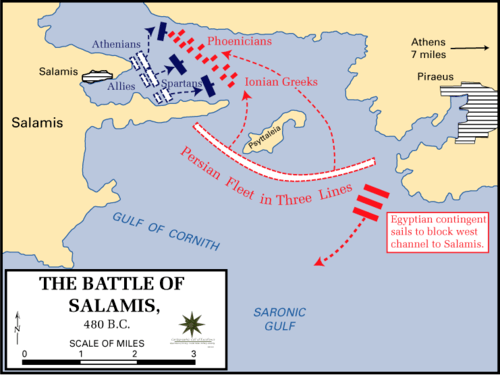
The Battle of Salamis occurred a month later, and largely due to a Greek bait. The Greeks feigned retreat into the tiny bay of Salamis. Historians contend as to whether the Persians entered the straits by nightfall, setting themselves up for battle that same night or if they simply blocked the passage inside. Xerxes also sent his Egyptian contingent of the Navy to circumnavigate Salamis, to block the passage off from the North. That morning, in 480, the Greeks would change the course of the war. The Persians were too numerous to line up their ships in single file, so had to line their Triremes two to three in depth – such a decision would cause major detriments to the Persians in the battle. In the inception, the Corinthian fleet sailed north. Meanwhile, the Peloponnesian, Athenian and Aeginetan contingents of the Hellenic force retreated further into the straits. According to Plutarch, they did this to get a better positioning and to wait for favourable wind. Then, just as it ‘seemed they would run themselves aground, a single ship came darting out of the ranks of retreating Triremes.’ (Holland, 2005). It would later be claimed by Herodotus that such men saw a phantom appear before them and claim ‘Madmen, how much further do you propose to back off?’ (Herodotus, 2003). The man controlling this vessel is acclaimed to be Ameinias – a hero of Marathon and an Athenian (The Aeginetines would also claim that the first ship was theirs). The rest of the Hellenic ships would follow quickly after and rammed into the first line of Persian Triremes; who immediately attempted to back up, only to be stunted by the second and third lines of Persians.
After this, it becomes difficult to accurately describe the events of the battle, because ‘no one in the straits had a view of the whole panorama of the battle.’ (Holland, 2005) Except maybe for Xerxes himself, who had once again placed himself on a nearby hill as to see the battle. In fact, the only way we can accurately depict the events of the battle is through “certain trireme aces”.
The first of these was Ameinias, who took his ship to the flagship of the Phoenician fleet ‘a towering vessel commanded by one of the Great Kings own brothers’ (Holland, 2005). The admiral lead a boarding party onto the Athenians ship, but was slain ‘as he made the jump’ (Holland, 2005). Such a moment changed the course of the battle, now that the leading admiral of the fleet was slain, order went into disarray on the Persian side. But Ameinias was not finished. The Athenian moved his ship to attack a second of the Great King’s commanders – Queen Artemisia of Halicarnassus (Interestingly enough, this was the same city where the famed Historian Herodotus was born). The Queen, seeing the Athenian captain bearing down on her, ‘found her escape blocked by the trireme of one of her own vassals – and so resorted to the startling expedient of ramming it herself’ (Holland, 2005). Ameinias, rightfully assuming the Queen had abandoned the Persian cause, quit the pursuit.
The battle was so devastating to the Persians that, it was said Shah Xerxes cried ‘My men have turned into women.’ (Herodotus, 2003). The Corinthian triremes that had been observed heading north were not, as Xerxes had originally thought, fleeing but, as Holland writes; ‘after scanning the straits which lay between Eleusis and Salamis… they had been engaged on a reconnaissance mission, making certain that the Egyptian squadron… was not now advancing on the Greeks rear. Which of course, it was not. The Egyptian squadron, as Xerxes himself was pain fully aware, was still eight miles from a battle… lurking in the westernmost straits, waiting for a Greek escape bid that was never going to come.’ (Holland, 2005). The battle ended soon after, those Persians who were forced ashore, and a group of soldiers who had been placed on Psyttaleia by the Shah were quickly dealt with by troops, led by the Athenian Aristides (Nicknamed “The Just”, he was Themistocles’ biggest opponent, but had been ostracised. The story goes that a blind Athenian man asked the man unknowingly to write his own name on the smashed bit of pot (how the Greeks would cast their vote), when Aristides asked why, he replied he was “fed up with hearing “the just” all the time”. It was said Aristides nodded, before writing his own name on the tablet and passing it back to the man. He had been recalled to Athens, after his ostracism lapsed). With about only half of the Persian ships who had entered the straits surviving to leave it.
The Effect of Salamis.
Such a victory changed the course of the war. The Hellenic Allies had taken on the entirety of the Persian fleet – and won. Such a victory against these odds can only be pinned down onto the bravery of the soldiers and strategic planning of men like Themistocles, Aristides and the other commanders of the Hellenic fleet. Following this defeat, Xerxes would learn of a revolt in Babylon – ‘the largest and richest city in the Great Kings dominions’ (Holland, 2005), and take the majority of his army with him to deal with it – he had all but given up hope on the ‘eccentric cities in a mountainous backwater’ (Holland, 2005) – Babylon was a far greater prize to keep than these terrorist states. He would however leave the rest of the army in Greece, with Mardonius, his cousin. As Holland says;
‘… and the Great King, reluctant to pass a second summer on campaign in Greece, no longer had any reason to oppose his cousin’s strategy. The scale and flamboyance that had characterised then expedition under his own leadership would be scandalously inappropriate once he was no longer at its head. As the task force’s new commander, Mardonius would be judged by only one measure: whether he succeeded in bringing the new satrapy to heel.’
Mardonius was allowed to choose the men personally to stay behind with him, allowing him to ‘cherry-pick the elite’ (Holland, 2005).
Meanwhile, the Greeks retired to the Isthmus of Corinth to celebrate their victory. The Athenians learned that Sparta had sent an embassy to the Persians, demanding reparations for the death of Leonidas, the Shah had laughed at the time, telling them they would receive their reparations from Mardonius, however the significant point here is that the Spartans, if given the right incentive, would be ‘prepared to tolerate the status quo’ (Holland, 2005). Still, the Hellenic allies gave them the benefit of the doubt – ‘None of the Greeks who had triumphed at Salamis had any interest in destabilising the alliance if they could possibly help it’ (Holland, 2005). Themistocles announced that ‘A black cloud has been swept away from the sea’ (Herodotus, 2003)
However, the Isthmus itself served as a fracture line between the city states. Sparta and the Peloponnesus, thanks to Salamis were now safe from Persian expansion – but the Persians still occupied Athens. Resentful of this, the Athenians ‘pressed loudly for a commitment from their allies to send an army north against Mardonius’ (Holland, 2005). The Peloponnesians refused, they were very happy to wait for the Persians to meet them at the Isthmus, where the geography was similar to that of Thermopylae. ‘and the more the Athenians attempted to shame them into action, harped upon as the victors of Salamis, the more their partners, snug and smug behind their wall, dug in their heels’ (Holland, 2005). They were at an impasse.
And here, it is where the tensions that would lead to the Peloponnesian Wars begin. The Peloponnesians, frustrated with Athenian cockiness over the Battle of Salamis, ‘made sure that the prize for civic achievement went to Aegina.’ (Holland, 2005). The Spartans knew that both sides had claimed ownership over the first of the ships to charge the Persians at Salamis, to give such an award to the Aeginetans was, to the Athenians, the greatest insult. Then, ‘rather than see Themistocles strutting about wearing the crown.’ (Holland, 2005), the Peloponnesians decided to split the crown between each of the Hellenic allies. The Athenian response to this was to start slandering all of their allies; ‘including… and accusation that the Corinthians at Salamis had headed north up the channel… because they were fleeing like cowards.’ (Holland, 2005). Such sparked infighting between the allies, whereby they were said to have thrown insults around ‘like mud’ (Holland, 2005). Only the Spartans had the sensibility to end it, they were painfully aware that the Athenian navy were key to the safety of the Peloponnesus and they could not lose it. Thus, Holland tells us that they resorted to ‘stroke and pet [Themistocles’] ego.’ (Holland, 2005). The Spartans invited the Athenian to their city where he was given the crown denied to him at the Isthmus ‘in recognition of his ability and cleverness’ (Herodotus, 2003). He was escorted as far as Tegea by the Hippeis – Spartan Royal Guard – an honour no foreigner had ever been given. However, within this, lay a Spartan message – No Spartans would leave the Peloponnesus.
In the spring of 479, the Hellenic Allies met at Aegina – to which the Athenians were noticeably absent. The Spartans sent the King Leotychides – a man described as ‘not altogether inspiring’ (Holland, 2005) – to investigate. The Athenians were steadfast: no ships would be contributed to the allied fleet until the Spartans sent an army north of the Isthmus of Corinth. The Spartans refused to buy the deal, calling the Athenians bluff. The second Impasse between the allies, and the tensions grew.
Mardonius meanwhile, sent King Alexander of Macedonia himself came with an embassy, to try and sue for peace – an offer looking very appealing to the Athenians at that time. They would become “friends of the Persians” but also retain self-government, their temples built at royal expense and expanse in territory. The Athenians, not to be too brash allowed a Spartan representative to sit in on the assembly. The Spartans, when it came to their turn to address the assembly ‘chose to prevaricate’ (Holland, 2005). They offered to take in refugees – perhaps the exact opposite of what the Athenians had been wanting to hear – and gave ‘high-minded lectures on the perfidious character of the barbarians’ (Holland, 2005). Still however, the Athenians declined, in response to the strength and size of the Mede army, they replied ‘We are already well aware of it. But even so, such is our love of liberty that we will never surrender.’ (Herodotus, 2003). Holland mentions that the Spartans would have been hard pressed not to be inspired by this strength of wills from the Athenians; ‘would have surely warned the Ephors that the crisis brewing in Attica did indeed imperil Sparta’. Aristides, now commander in chief of the Athenian army and Navy (Themistocles had lost command in an election, the command being given to his arch-rival Aristides “the just”.) called for the Spartans: ‘Quickly, before Mardonius appears in our country, you must join us and confront him in Boeotia.’ (Herodotus, 2003).
The Battle of Plataea, 479
By now, spring had turned to June’s summer and the Spartans were once again, celebrating another festival – the Hyacinthia (Named after one of the God Apollo’s dead lovers.) An Athenian embassy came to the city, desperate for military assistance. ‘Behind the scenes… wheels were already turning’ (Holland, 2005) in the Spartan city however, for after being kept for 10 days, the Athenian embassy exploded in rage, issuing an ultimatum: ‘either the Spartans abandoned their festivities and went to war or the Athenians would be obliged to accept Mardonius’ terms.’ (Holland, 2005). The Spartans acted in the usual cool, calculated Lacedaemon way – for had the Athenians not heard? The entirety of the Spartan army was on the march. This act is accurately described by Holland – ‘A true coup d’ théâtre’ (Holland, 2005). The Spartans had been unwilling to commit troops beyond the Peloponnesus for the same reason as Thermopylae – fear of Argive attack. Such a move from the Spartans had not only fooled the Athenian embassy, but the entire Argive court too ( The Argives had promised to destroy any Lacedaemonian army that passed by them, which also adds to why the Spartans hesitated.) The Argives woke up to the Spartans already at the Isthmus – they had been bypassed. ‘The whole fighting force of Lacedaemon is on the march and we are powerless to stop it.’ (Herodotus, 2003) the Argive King would tell Mardonius. The latter withdrew quickly from Attica to Boeotia and made his stand – a small town outside Thebes called Plataea.
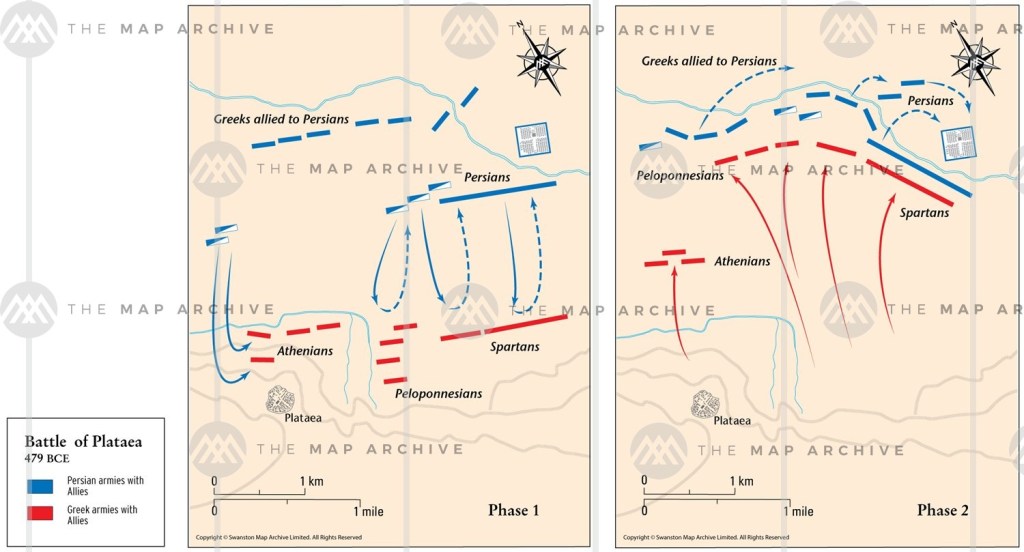
The Spartans were led by King Pausanias (He was technically a regent – son of the Regent Cleombrotus, who had taken over as regent after Leonidas’ death because the latter’s own son was too young.) – described as young and arrogant – and the army was at least 5,000 strong, meaning about three quarters of the total army had been spent on the expedition. Among them was said to be a man named Aristodemus – one of two men who survived Thermopylae. They had been injured with eye inflammation and so had left, whilst Sparta and the other city-states that volunteered to stay behind died. Such cowardice was unacceptable in Sparta and the two were duly named a “trembler” – the most shameful word in the Spartan lexicon. Such men were essentially ostracised by society and treated by dirt – so much so that the other Spartan to escape Thermopylae with his life committed suicide. Aristodemus however was given a second chance, allowed to fight at Plataea to regain his honour.
The Spartans met Athens and the other Hellenic allies at Plataea, and slowly crept forwards into position. Mardonius had chosen his troops well, for with his army were the Horse-Archers of Saka. It was a second Marathon. The Hellenic allies could not fight whilst the cavalry was on the field else it would be a rout. The build-up to the battle was long and tiresome, only coming after Mardonius forced the Greeks to disperse and retreat. The Spartans, facing the Persian force itself, while the Athenians faced off against Thebes, found themselves a relatively quick victory for Mardonius was quick to fall. When the Persians saw this, they knew the battle to be lost and began to run – a rout. The Athenians too fared better, after they routed the Thebans and sent them fleeing for their city. 40,000 of the Persian forces had managed to flee up to Thessaly, but the rest were decimated after attempting to find shelter in a fort.
The End of the War.
The Greco-Persian Wars officially finished in 479, after the city of Byzantium (later to become Constantinople, capital of the Eastern Roman Empire, and then Istanbul, current capital of Turkey.) was liberated by combined Greek efforts. Following Plataea, the Hellenic Allies pursued the fleeing Persians up north, through Thessaly and Thrace – right up to the Hellespont and pushing them across the Bosporus – the traditional separation between Greece and Persia, East and West. Sparta would withdraw back to the Peloponnesus, seeing their jobs as finished, much to the Athenians frustration. They would continue on for almost 30 years “freeing” the Greek states. Sparta however, was finished so this is where most historians end the Greco-Persian Wars.
 The History Book