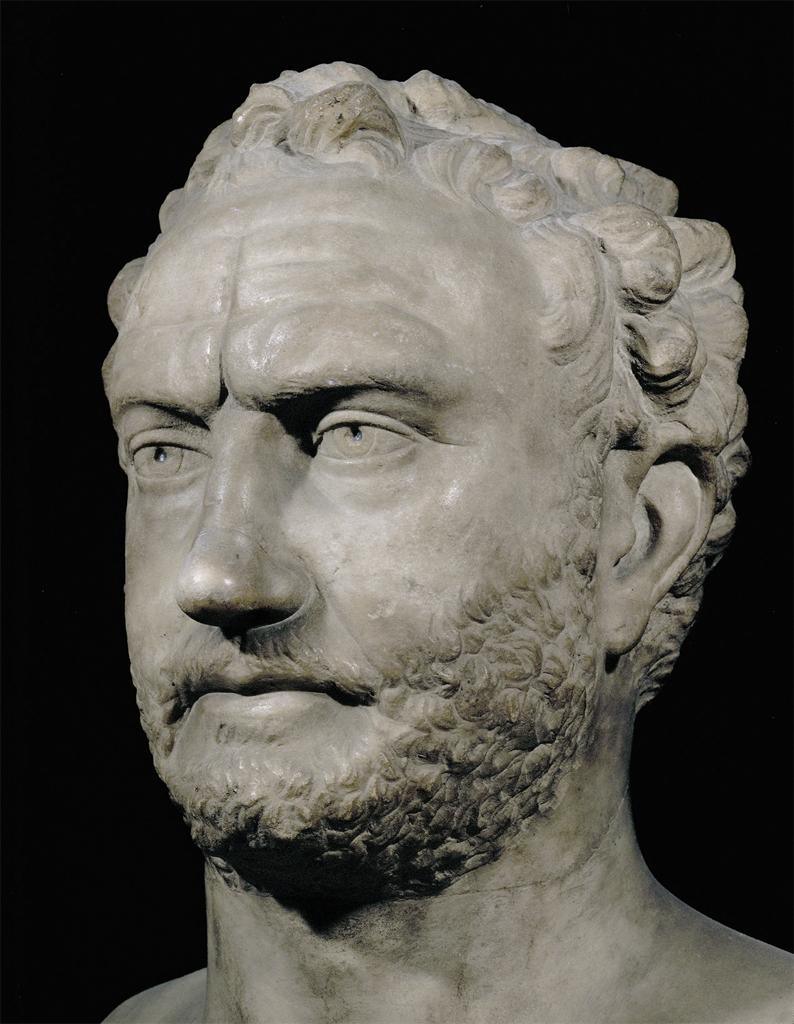
What made war inevitable was the growth of Athenian power and the fear which this caused Sparta.
Thucydides (Rex Warner translation)
Thucydides was the second historical heavyweight of the Greek world, and direct successor to Herodotus. He wrote a history of the Peloponnesian War, and in the eyes of many historians he is the greatest example of an objective first-hand historian. By far, Thucydides is my favourite historian to have lived.
Much of what Thucydides wrote continues to affect us as humans in many different ways, even today. From ‘War is a violent teacher’ to his very pessimistic view of Human Nature, his influences can be seen in recent history and indeed politics today. One of these many influences is the Thucydidean Trap.
I first came across the Thucydidean Trap whilst studying for my Extended Project on 5th Century Greece last year. It fascinated me and I quickly began to research further examples of the Trap (which I believe was the reason I looked into the Second Punic War in any real depth for the first time), and I wasn’t disappointed. It took me from University Lectures, to Debates between historians, one of which’s subject I shall end on.
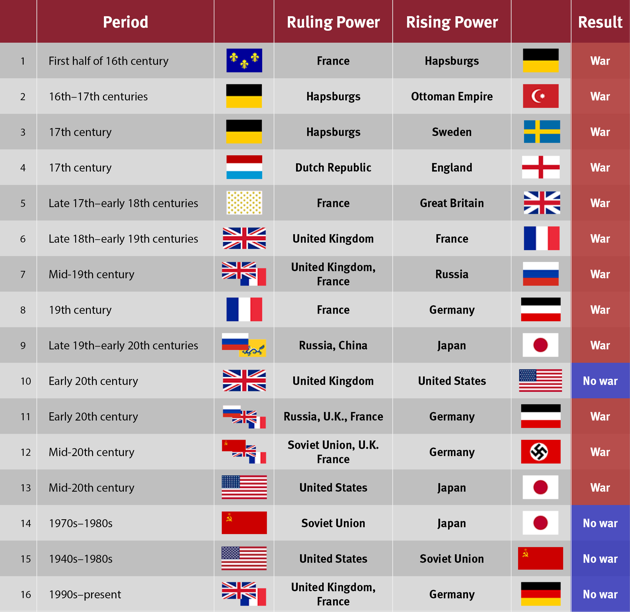
The trap is a theory that’s adapted from the code written above. Extrapolated from Athens and Sparta to apply to many conflicts throughout history. In layman’s terms, it describes a scenario when one power’s dominance is threatened by a rising power, as Sparta’s traditional hegemony over Greece was challenged by the rising power of Athens after the Persian Wars 599-479 BC. It is a theory I absolutely subscribe to, below I will put an info-graphic of examples of the Thucydidean Trap since the 16th Century, and then go into depth on a few poignant examples from across history, and show how the Thucydidean Trap has affected history in profound ways.
The Peloponnesian War is the first such of these examples. After the heavy infantry of the Greek Hoplite beat back the lightly armoured Persian infantry in the Persian Wars through a combined Spartan lead Hellenic League and the leadership of the likes of Themistocles, Aristides, Leonidas and Pausanias; Athens became stronger and stronger. After the Spartan’s pulled out of the Hellenistic League (thus pulling out the entire Peloponnesian League) after they liberated Byzantium (modern-day Istanbul – the Hellespont was seen as the separation between East and West, Greece and the Barbarian), Athens took control of the League and continued to wage war against Persia on her own. In 478, the Delian League was founded on the Island of Delos in the Aegean. It was originally created to be a Defensive Pact against Persian aggression, where all would pay into a collective fund to mount a better defense if invasion ever seemed like it would occur again. However in 448 the Peace of Callias (although the historical debate is out on this as to whether it actually happened) was signed between Athens and Persia, both agreeing that they wouldn’t attack each other anymore. Yet Athens did not disband the Delian League, and by the late 440’s, many in Athens were openly referring to the League as an Empire. The Tribute system was transferred from Delos to Athens itself, and Athens used the funds to build the most famous building in Greece: the Acropolis. Quite shortly after this, the Empire fell into trouble: Athens dragged the League (The Delian League remained its official name, so I will continue to refer to it as such, however be aware that it was an Empire at this time) into a conflict between Corcyra (Corfu) and Corinth, who was a major player in the Peloponnesian League; many islands and states in the Aegean also chose to revolt against Athens, much to their demise. However the state of Potidaea in Chalcedon managed to get Spartan promises of aid if they revolted. Further, the state of Megara, another major player in the Peloponnesian League had recently received a trade embargo from Athens (known as the Megarian Decree). As Athens was beyond doubt the dominant power on the seas, not even Corinth could match it, Megara’s economy crumbled.
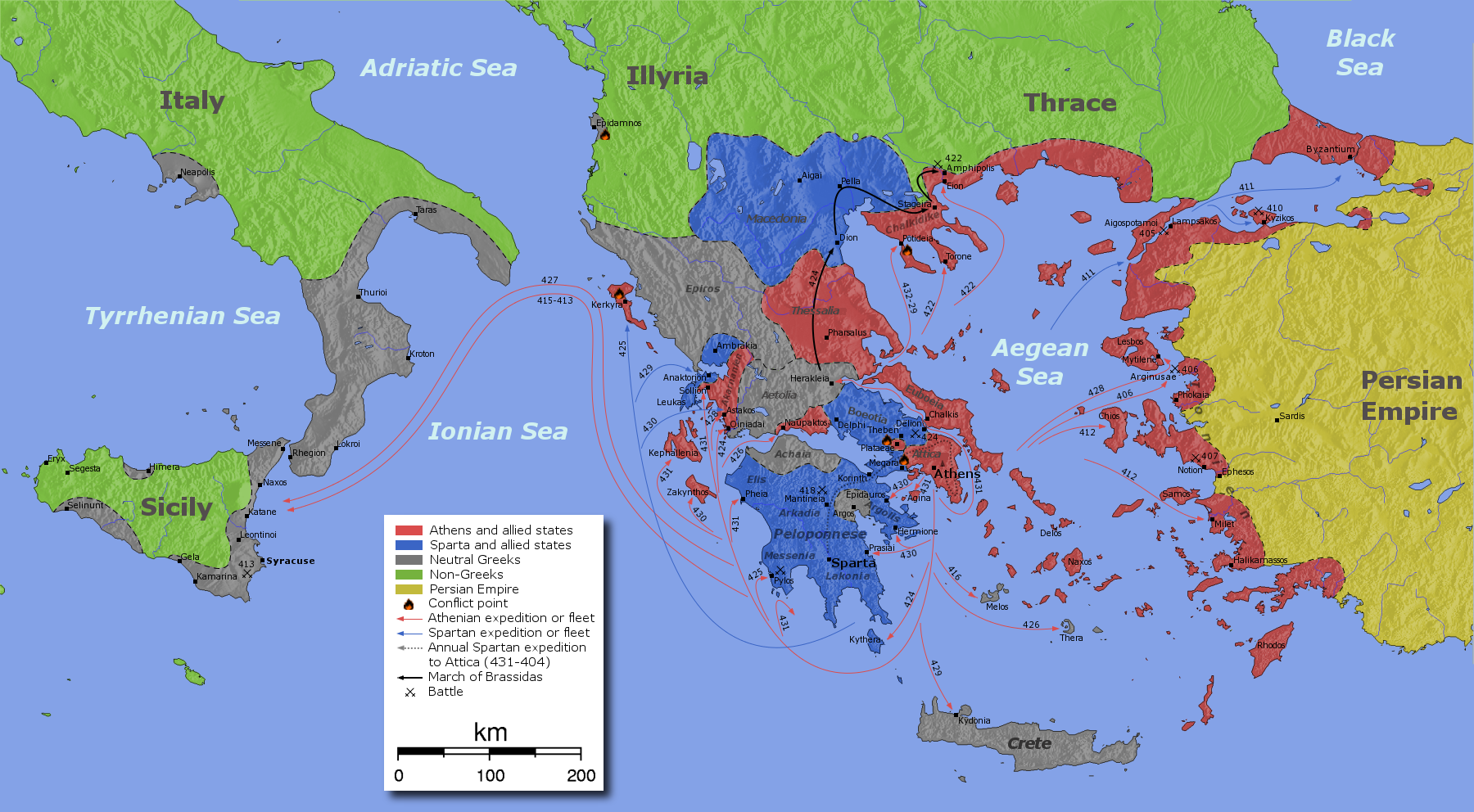
Although officially, Sparta declared war over the issues presented here; it is clear that the fear instilled in Sparta over Athenian emergence pressed them into war. Sparta had been, since the middle of the 6th century BC, the hegemonic power in Greece. The Delian League challenged that, and the flexing of Athens economic and militaristic muscles compounded that fact. The Peloponnesian War is very significant for many reasons, however perhaps the easiest to see one is that the war crippled the entire Greek economy, manpower and life in general, so much so that it would never really recover. Athens would never again be a strong power in the Mediterreanean. Sparta had exerted so much of its manpower in the war and so many Spartan soldiers, that the population of Spartan citizens fell dramatically. By some accounts, the delicate balance required to keep Messenia (the subjugation of Messenia allowed the Lacedaemons to press all males into military service, unlike every other state that had to rely on citizen levies) under control of 3 Helots to 1 Spartan soldier during the Persian Wars, into 10:1. By the 370’s, this had become too much and Messenia gained its independence after Thebes liberated it. All of this meant that there was no state strong enough to even attempt to defend the rest of Greece against Philip II of Macedon, which in turn gave rise to Alexander the Great.
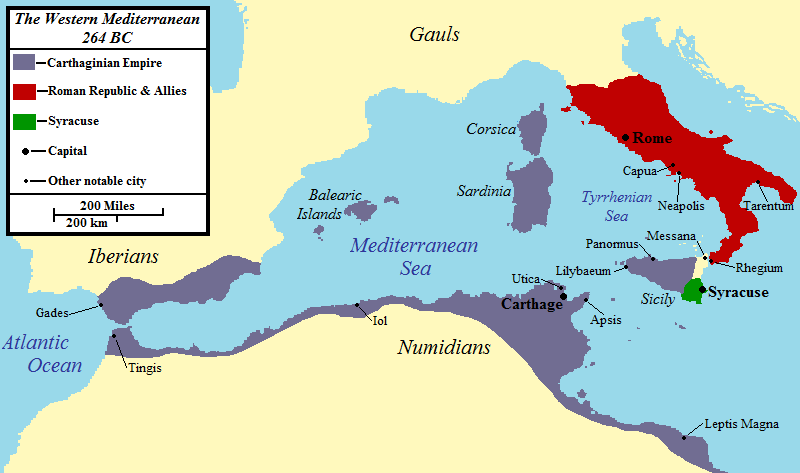
The second example is another close to my heart, the Punic Wars. Writing at length about why Carthage lost and why Rome won is for another post, however I will briefly outline why the war started in terms of the Thucydidean Trap.
Carthage was the proven power of the Mediterranean. It controlled most of North Africa, Corsica and Sardinia, and Sicily as well. It was the richest power in the Mediterranean as well, and most in the Assembly of the City-State were keen on pressing more for economic and mercantile prowess than any kind of militaristic one. Rome, by contrast had recently conquered most of the Italian Peninsular. Rome always tended to be more of an imperialistic power compared to Carthage. The First Punic War began over almost comical reasons, due to Italian bandits on Sicily appealing to Carthage, and then later Rome for help. This brought the two into war. However, as you may have realised, the comical reasons for this war suggest that war was almost inevitable anyway, and it was in fact the fear induced in Carthage due to the rise of Rome that precipitated war, and most historians are in concurrence with this idea. The Second Punic War was the reverse, with Rome now being the hegemon and Carthage wanting it’s place as foremost power of the Mediterranean back. The Third, and final Punic War came due to Roman fears that Carthage remaining in any capacity threatened Rome. So in all Three Punic Wars, the Thucydidean Trap’s influence runs strong and never really falters. The Punic Wars obviously allowed Rome to fashion its Empire almost unopposed, and thus without Roman victory, European history would likely never be the same.
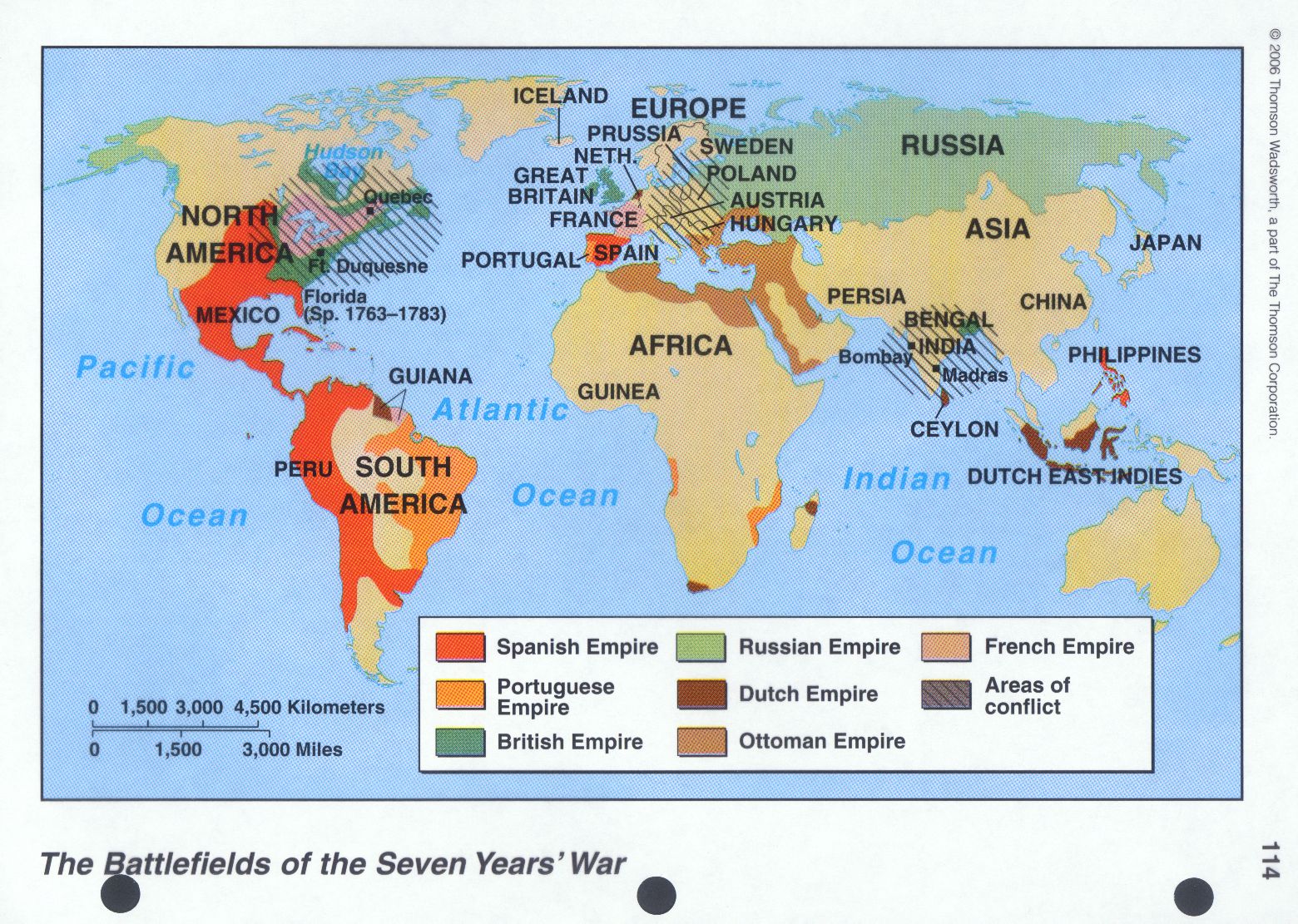
An example closer to our time, yet equally as potent is the Enlightenment’s version of the Punic Wars – The Seven Years War, 1756-1763. This saw France, the most powerful nation in the world at the time, take on Britain, the emerging power who concentrated most of its effort in its navy. No one else at the time could really match France. Indeed, the very, very early signs of industrialisation were beginning to show in Britain at this time, such as the invention of the Spinning Jenny. What precipitated this war was the swapping of alliances between France and Britain, Prussia now allied with Britain and Austria France, in 1756. This was known as the Diplomatic Revolution. Largely Britain found itself allied with Prussia to protect Hanover, its elector of the Holy Roman Empire state in Europe. The war would essentially decide who took control of the global hegemony, and become the worlds foremost power. Thanks mainly to William Pitt the Elder’s battle strategy of beat France in battle in almost every corner of the globe except Europe, until her Empire crumbled and then aid Prussia in Europe, Britain won. This war would not only allow Britain to fashion its global ambitions, and conquer almost 1/3 of the Globe but as a result of this war, the American Revolution occurred (in layman’s terms; Britain raised taxes to pay off the debt incurred protecting the American colonies from the French, despite the taxes being much lower in the colonies than they were in Britain, America rebelled) and France helped to gain them independence as pay back. The combination of debt’s incurred during the 7 Years War and French Revolution (America refused to pay France for the help given), France went bankrupt and a series of tough harvests created the perfect conditions for a revolution in 1789. The Revolution gave rise to Napoleon, and through his conquests, laid the ground work for World War One (another good example of the Thucydidean Trap).
The Thucydidean Trap has many examples since the Seven Years War – World War One and Two, the Cold War. One may think that the last one listed by the info-graphic of Britain and France vs a united Germany in the 1990’s was the last such example, and since the Cold War, we’ve had no such major Thucydidean Trap to deal with. Yet this is wrong. We are, right now, living in a Thucydidean Trap – the United States of America being challenged by the People’s Republic of China. After coming across a debate between historians, featuring a one Niall Ferguson, on whether this very scenario was true or not, I decided to write this article. By many accounts, China is already stronger than the United States – certainly economically in most areas other than GDP. Ferguson argued that we are indeed living inside a Thucydidean Trap, and that the USA is vastly unprepared for it. One poignant point he made is that most people, despite not liking the man, don’t actually know much about President Trump or how he thinks. But the Chinese do. According to Ferguson, the Chinese bureaucracy have read Trump’s ‘The Art of the Deal’, and he claims the book contains all the information needed to understand how Trump approaches the Presidency and Foreign Policy.
So that is the lesson I would like people to take away from this blog post – make no mistake; we might be in the ‘most peaceful period in human history’, but that peace hangs on a knife’s edge. The West, I think, has been sat too comfortably on its Laurel Wreath of victory after the Cold War. After the Peloponnesian War, when Sparta finally won in 404, it did little to cement its victory or take advantage. It was content with the status quo, wrongly thinking things had returned to the days when Sparta could sit unopposed, safely tucked away in the Peloponnese. It even pulled out of Athens after a few years and paid little attention. By 379, 100 years after a Spartan lead coalition defeated the Persians at Plataea and liberated Greece from Thebes to Byzantium; Thebes (a state that had always had the potential to be very powerful, but always stayed as a middling power) would defeat Sparta and take control of Greece (albeit very weakly and would later get smashed by Philip of Macedon). Sound familiar? Change the names slightly and you have America ‘defeating’ the Soviet Union in the Cold War, and doing little to consolidate or take advantage of this victory, instead just sitting comfortably on its victory – wrongly thinking things had returned to the status quo; meanwhile a country that’s always had the potential to be powerful is creeping up behind it; China. China poses the greatest threat to the United States and the West today, but little is being done about it. We are experiencing the beginning of a Thucydidean Trap.
I think it’s clear that the Thucydidean Trap was not just a one time occurrence, and it has continually appeared throughout history, at turning points of nations and some of the most poignant moments in history. Little can be known about what will happen in the future, but this I am sure of: The theory of a man over 2,500 years old will continue to affect us, even if Thucydides’ name gets lost along the way.
 The History Book