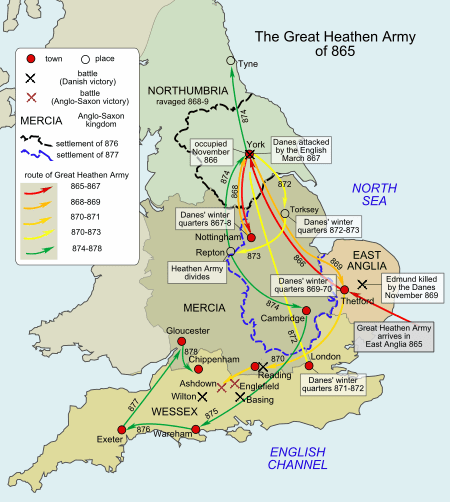
In 865, an invader force landed in England. For the first time since Hengist and Horsa, the fledgling nation was about to undergo an ethnic revolution. Centuries earlier, the Celtic peoples had been displaced by the Germanic tribes grouped under the umbrella term Anglo-Saxons. The Saxons forged into the island of Britain a heptarchy – seven monarchies. Throughout the ‘Saxon Golden Age’, the seven kingdoms oscillated in their independences. Some kingdoms grew bigger, then were forced to shrink by the others. Others were made vassals of other kingdoms, only to find their footing under a whole host of now mythological kings. By the 9th Century, the Heptarchy had become a Quadarchy, so to speak, as the kingdoms merged and molded.
These Kingdoms: Wessex, Mercia, East Anglia and Northumbria, all coexisted somewhat peacefully, through centuries of complicated alliances and royal marriages. It was all going so smoothly.
However, in a steady stream, like water from a tap, the Invaders had begun to arrive.
At first, these were small raiding parties. The first, in 793, had raided the holy island of Lindisfarne, and promptly returned. To the general populace of Anglo-Saxon England, this was a plague; a challenge sent by God to test the loyalties and the purities of his people. To those who followed the un-Christian traditions of Anglo-Saxon myths, these were literal dragons, carrying beasts in human form to wipe out humankind. They were not.
In Scandinavia, life was changing. The environment was slowly suffering as year after year of bad harvest harried the people, and the population, due to unrelated factors, was growing. There was less food for more people. And as of 793, they had found a distant land much more fruitful, with weak and easily conquerable people, and riches in the form of the Church’s wealth was really, really easy to steal.
And so, the Scandinavian Dream became less to raid, and more to colonise. Men and women turned their eyes westward not for their personal glory, but for a home for their weak and their young. The culmination of this lust met in the year 865.
The name Great Heathen Army paints us a distorted picture of the truth. The name insinuates one army, a union of Scandinavian soldiers, organised and structured, numbering in the thousands. It was far from that; the Great Heathen Army was in many ways closer to a migration.
The Scandinavian peoples of Denmark, Norway, and more recently their colonies in Ireland, followed a patron/client way of life. A man or woman owed their life and wealth to another, stronger and more powerful – often a jarl (earl), sometimes a king, but more often than not the patron wasn’t titled. These leaders showed their loyalty by granting their followers arm rings, land, livestock, or even loyal men of their own. At the top of this clientele chain sat any number of figures, loyal only to the gods. At the time of the Army, there were several in England alone.
Halfdan, and his brother Ubbe, were two legendary viking warriors, emblazoned in modern culture – Ubbe is a main character in the TV Series Vikings. They were prominent in the conquering and dominating of Northumbria, and its reduction to Scandinavian land. This would become the Danelaw.
Guthrum is similarly legendary. He was one of several men tradition remembered as the killer of King Edward the Martyr. Whether he did or not, he would take Edward’s Kingdom of East Anglia as his own, and become the first Viking king in England. This title can also be considered for Halfdan Ragnarsson, who was King of York, although his was hardly a firm monarchic rule.
Another, Ivar the Boneless, known better to historians as Imar, was a Viking leader who became joint King of Dublin, a vital Viking port, and founded a dynasty that would flourish across Viking Europe for many decades to come.
Figures such as these were not only great warriors, but great rulers. In their appropriate regions, they led the colonisation of Viking territory – the Danelaw – causing the creation of England as an Anglo-Danish land.
The Great Heathen Army was so much more than an invasion. To the Scandinavians it was a new world, to the Saxons, it was a plague. However, these differences would, over the generations blur, and merge to form the basis of what we understand England to be today. For a conquest unparalleled by any others bar the Norman Invasion and the Great Migration, the Great Heathens are comparably forgotten to history.
 The History Book