
Istanbul is a city with a more interesting history than cities like London and perhaps even Rome itself, and certainly has existed for a longer time. Istanbul has one of the most interesting histories in the world: from being settled by the Ancient Greeks; to the capital of the Roman Empire; to being the city at the edge of Europe; falling to the Ottomans and having its entire culture changed; to today where it remains in Islamic hands. So that I remain historically consistent, I will refer to the city as it was referred to at the time – So Byzantium – Constantinople – Istanbul.
The importance of a city like Istanbul can be seen by its geography. Lying at the mouth of the Bosporus River that connects the Black Sea to the Mediterranean, it stands at the forefront of some of the worlds greatest trade networks. Settled in the 660’s BC by the Megarians (A region of Greece neighboring Attica, where Athens is) and named ‘Byzantium’, it quickly established itself as a fruitful city. During the Persian Wars, it fell under Persian occupation and they instantly saw it for its value. Despite only recently coming into their hands, it quickly became one of their most active port cities. When the tide began to turn against the Persians in the Wars, there seemed to be almost a race between the now rivaled states of Athens and Sparta of who would control the city. Due to internal politics within Sparta, Athens won. Byzantium was one of the founding members of the Delian League.

Athens recognised the strategic importance of Byzantium. When tensions with Sparta heated up, Byzantium became key to Pericles’ (An Athenian Statesman) strategy. Athens’ long walls in Piraeus allowed it to hide within its city’s walls, and import grain from the fertile regions around the Black Sea. Control of Byzantium was key to maintaining this strategy. Sparta recognised this too, and very quickly attempted to seize control (much to Byzantium’s gratitude due to the Delian League quickly becoming an Athenian Empire, which Byzantium wanted out so they constantly rebelled throughout the war). One of the largest battles of the war – Amphipolis (which actually contained the primary historian of the Peloponnesian War – Thucydides – as a General. The Athenian defeat would lead to his ostracism (essentially a banishment) from Athens) was fought for control over Byzantium and its surrounding region. Already, a mere century after Byzantium was settled by Megara, big players its world at the time were fighting for control.
Throughout the Peloponnesian Wars, it played a hugely important side role for both sides. When the the Athenian attempt to conquer Sicily failed – resulting in huge casualties and the loss of some of their best Generals – Byzantium was one of the first cities that rebelled as the Athenian Empire fell apart; and it was the first city that Athens tried to get back. Throughout the last decade or so of the war, a brutal battle was fought between what remained of the Athenian fleet and the newly established Spartan fleet (funded by the Persian Empire, which is a story I shall do soon). Lysander’s strategies soon proved the better of men like Alcibiades and Thrasybulus. Byzantium was brought under Spartan control. Shortly after, Lysander beat Athens once and for all at the Battle of Aegospotami. With no more armies or fleets to protect herself, Athens surrendered.
All throughout this first century of its existence, the city of Byzantium played an important role. From being the first city standing in Shah Xerxes’ way as he crossed the Hellespont in the Persian Wars, to being the lifeline of early Athenian military policy and being the city who’s successful rebellion helped to make Athens lose the war. However, the Peloponnesian Wars essentially ruined Greece. Thousands had died and entire cities had been reduced to rubble, not to mention the riches city in Greece (Athens) was now bankrupt. All states were left weak. Macedonia would conquer the rest of Greece around 60 years after the end of the Peloponnesian Wars, and they would be unified. However, the spheres of power quickly shifted and as Rome and, particularly Carthage, became greater powers in the Mediterranean, the Greek world took a backseat, with Byzantium along with it. It would still remain a huge trading port, but now that one sole state such as Macedon or the Romans themselves would rule it practically unchallenged for hundreds of years, it became more of a footnote in history as opposed to a somewhat big player. Byzantium would also not benefit from the more global trading network. Byzantium benefited when trade flowed through the Bosporus and when the Greek states traded among themselves; but when Alexander reached India, it gave opportunity for trade there. Augustus Caesar upon coming Emperor, recognised the value of trade with India and enhanced it. Through the first three centuries of the Roman Empire, trade through Egypt (which became the Bread-Basket of the Empire, thus the Romans didn’t need to import much grain from around the Black Sea, further damaging Byzantium) through the Red Sea and to India became one of Rome’s primary and most valuable foreign trading partners. Byzantium seemed to be left behind in an ever wealthier world. But this would all change in the Crisis of the Third Century AD.
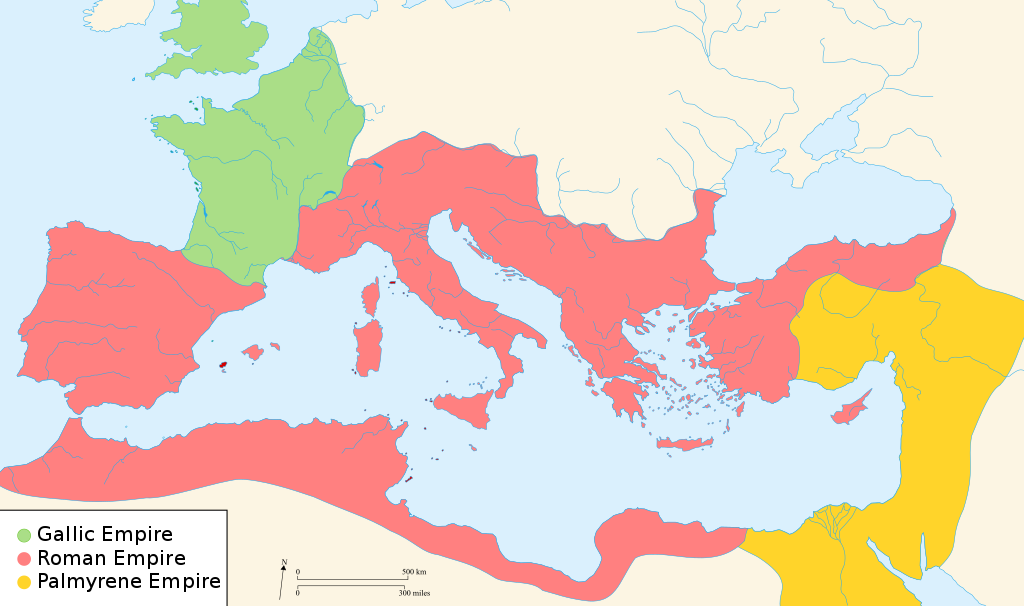
The Third Century Crisis was a political struggle for almost a century within the Roman Empire. It began with the assassination of Severus Alexander in 235 by his own troops, initiating a period where the Empire nearly collapsed from barbarian invasions, civil wars, peasant revolts, instability, multiple coups, and even climate change! In this time, the Empire fractured into the Gallic Empire, the Palmyrene Empire and what was surviving of the Roman Empire. Whilst the Empire was reunited under Aurelian, it took Diocletian to fully end the crisis in 284. In that time, the Sassanid Persians had attempted to invade the Empire, and would have succeeded too, if not for the Palmyrene’s lead by Odaenathus (Long story as to why they then became a separate empire, and I may cover it one day). Rome had become within a breath of complete collapse. It’s leaders knew this. Change was required.
The biggest enemy to the Empire at the time was the aforementioned Persians. While Rome boasted the best road network in the Ancient World, it was still not fast enough to carry messages between Rome and the eastern fronts. They needed to be closer. Compounding this was the fact that for centuries, the East had been the powerhouse to the Roman Empire. Unlike today where it’s Western Europe that was wealthier, in Rome, the East was the only part of the Roman Empire that delivered a surplus in tax revenue, control over places like Britannia and Gaul was supplemented by the surplus they received from places like Egypt. Without control of the East, Rome couldn’t fund the West. So, when Emperor Constantine rose to the Caesarship in 306 following his Victory at the Milvian Bridge, he moved the capital. From Rome, he’d found his own city. He would build on top of the now derelict city. One on the shores of the Hellespont. On a city, called Byzantium.
Constantine the Great, in his supreme City-Naming skills, would name the city ‘Constantinople’. A lot of what was in Rome and various other cities within the Empire was moved to Constantinople, meaning that Hellenic art from across the Empire could be found within the city. During the building process, to encourage citizens to settle in Constantinople, Constantine ended up handing out 80,000 rations a day. Once it was consecrated on 11th May 330, it was one of the largest and most beautiful cities in the world. Accounts claim that it was simply referred to as ‘New Rome’ by the Romans; ‘the city’ by Byzantines; ‘Throne of the Romans’ by Persia; ‘The Great City of the Romans’ in Arabic and my personal favourite: ‘The Queen of Cities’ by many European countries. And, to top it all off: It only took 6 years to build the city!
When the Western Roman Empire fell in 476, the Eastern Empire lived on. (Essentially by this time, the Empires had been split in two in the attempt to make administration easier, but the West collapsed quite quickly). In fact, it lived on for over 1,000 years more. By the 5th century, Constantinople was the largest and the wealthiest city in the entire world. It was 20 times bigger than London and Paris. It boasted the most impressive set of defenses ever seen before in history. A set of double walls, the inner of which went into the Bosporus and connected onto the other side, with palisades and a moat around the outer wall. The development of Greek fire was also considerable and the defenses of Constantinople included ships with literal flamethrowers on them (although, as the ships were built of wood, sometimes the Greek Fire would harm themselves as much as the enemy). For those who don’t know, Greek Fire was this petroleum-jelly like substance that they Romans managed to develop (no one quite knows how they managed to do it, and don’t know how to recreate the stuff) that could literally burn anywhere – even underwater. Enough about Greek Fire though.

Constantinople was said to be impregnable. And it was. For 900 years, Constantinople withstood every attack. As Europe tore itself apart with Feudal Kings declaring war on each other every which way, Byzantium stood strong. It even managed to take back some of the lost lands of the Roman Empire. Within the city, it hosted some of the greatest works of all time. The horses of St. Mark, the chariot track, built by Constantine and perhaps the most glorious of all: The Hagia Sophia. This monolith of a Cathedral deserves its own history, but suffice to say this church (which still stands today, so if you find yourself in Istanbul – go see it!) is one of the greatest marvels ever created, when accounting for the time it was built. Built by Justinian after the previous Cathedral collapsed in an earthquake, for 1000 years, it boasted the biggest dome ever created (Might not sound impressive, but dome’s are really hard to built, so the fact they were able to build a dome not surpassed for 1000 years shows its marvel). It was only beaten by the Maria Del Fiore in Florence. It was built specifically to have a bigger dome, after Constantinople fell to the Ottomans. Within the city as well were some of the greatest minds of the world. When Constantinople fell, many christian thinkers fled to Western Europe. The thought they brought with them was the catalyst that sparked the Renaissance – quite literally the ‘Rebirth’ of Europe.

The history of the Byzantine Empire requires… like a lot of articles… so I’m not even going to attempt to run through the entire history of the Empire here. But what is important to know is that much like London is to the rest of the UK, Constantinople dominated the Byzantine Empire. Whilst the Byzantines had other great cities like Antioch and Damascus, Constantinople was, as the Byzantine’s called it ‘The City’. Seeing Constantinople in its heyday under the rein of Justinian must have been no less than magnificent.
Obviously, the city must have fallen, else Byzantium may still exist today. The city first fell in 1206, during the Fourth Crusade. Crusaders, unhappy with the lack of pay decided to sack the closest city – Constantinople – of whom, had originally called for the crusade in the first place. For months, Crusaders sacked the city. The aforementioned Horses of St. Mark were stolen, and moved to Venice. Following the crusade, as was tradition: a Crusader kingdom was set up. Suffice to say, it was pretty terrible. The ‘Latin Empire’ lasted from 1204 to 1262 before Emperor Michael VIII Palaiologos retook the city for the Byzantines. But it was never the same. In that time, the new Muslim Caliphates swept through old Byzantine lands, conquering everywhere bar Greece and half of Turkey. Bulgaria conquered the Balkan regions. The walls of Constantinople had also been devastated. They were weak in several places, and were never really repaired properly. Byzantium was never the same. It was weak, defunct. A shadow of its former glory.
By the early 15th century, the Islamic Caliphates had turned into the Ottoman Empire, around the same time as the end of the Islamic Golden Age. The Ottomans had eaten up the rest of the Byzantine land, until only Constantinople remained. The last bastion of the Roman Empire. Up until 1453, when it fell to Ottoman Sultan Mehmed II, it had essentially existed as an Ottoman client state. It couldn’t actually do anything, but the Ottomans had yet succeeded in taking the city, due to its near impenetrable defenses. The city was built to withstand any invader. But these walls were centuries old. But they were not built to withstand Mehmed’s greatest asset: cannons. A modern invention that was yet to properly take hold in Europe, Mehmed had the upper hand. In a 52 day siege, Mehmed sent wave after wave into Constantinople. The majority of the siege was actually spent attempting to break through the walls of the city, while they weren’t meant to withstand cannons, they still managed to hold the Ottomans off long enough. The siege of Constantinople is another topic I definitely plan on covering so I won’t go into much more depth. But it should be worth noting that arguably, the only justifiable excuse for a crusade was when Constantinople was under threat. Where the ‘Holy Land’ had always belonged to a mix of races and was by no sense of the word ‘Christian’, Constantinople had always been a part of Europe. Yet virtually no help came. Countries in Europe by this time had lost interest in Constantinople. And so it fell.
Despite popular belief, the cities name was not officially changed to ‘Istanbul’. Officially, the name remained Constantinople (largely because the Ottomans, peculiarly, saw themselves as the heirs to the Roman Empire). By this time however, Constantinople was no longer the largest nor the wealthiest city in Europe. It only further declined under the Ottomans. Firstly because the Ottomans were no longer encouraging thought as their Golden Age had ended in the 12th century, but also because the nature of trade had changed. Spain and Portugal were the primary factors in this. Because Constantinople was no longer Christian, they did not want to be taxed by it and trade along its routes. As such they found different routes to the all important spices. For Portugal, this meant travelling around Africa. For Spain, it meant thinking they could go around the whole globe and accidentally discovering a whole new continent. Funny what you can find in three tiny ships with a slightly delusional captain (Columbus thought the world was pear-shaped guys).
Fun fact about the Ottomans: they liked to have stability in the Empire, so the ruling Sultan would usually slaughter rivals to his own throne and his heirs. Then the heir, when ascending to the throne would rid themselves of any rival that their predecessor did not remove. This lead to some weird results. For instance, Suleiman sent an ultimatum to his eldest son Mustafa to show that he had no intentions of usurping him or causing trouble. Mustafa did so, entering his fathers tent unarmed and without any guards. Suleiman had him slaughtered anyway, it was said that he regretted this decision heavily in his later life due to how good of a Sultan Mustafa would’ve been.
Despite this, there were times in which Constantinople prospered, such as under Suleiman the Magnificent where the Ottomans nabbed up the rest of the Balkan regions, making their way to the gates of Vienna, where the first unsuccessful attempt was made of taking the city. In order to pacify these newly conquered Christian regions, Sultans would displace the Christian populations with Muslim ones, in the hope that Muslims could encourage Christians to convert. To say the least, this had mixed results. Most of Europe stuck with its ancient heritage. Though it did manage to mix up the ethnic groups within the Balkans meaning that, for example, no Greek or Macedonian can really claim true ethnic heritage to Alexander the Great due to how muddled the ethnic groups have become. Though, we cannot blame the Sultans for doing this, such was a common practice at the time (looking at you James I with your Ulster Irish plantations.) Further, during the Ottoman period, the second great religious building would be built: the Sultan Ahmed Mosque; built by… well, Sultan Ahmed (they really weren’t creative with names) in the early 17th century. Better known as the Blue Mosque, this beautiful structure was built in an attempt to surpass the Hagia Sophia’s glory. In beauty, it does but I personally don’t believe a single church can stand up to the Hagia Sophia.
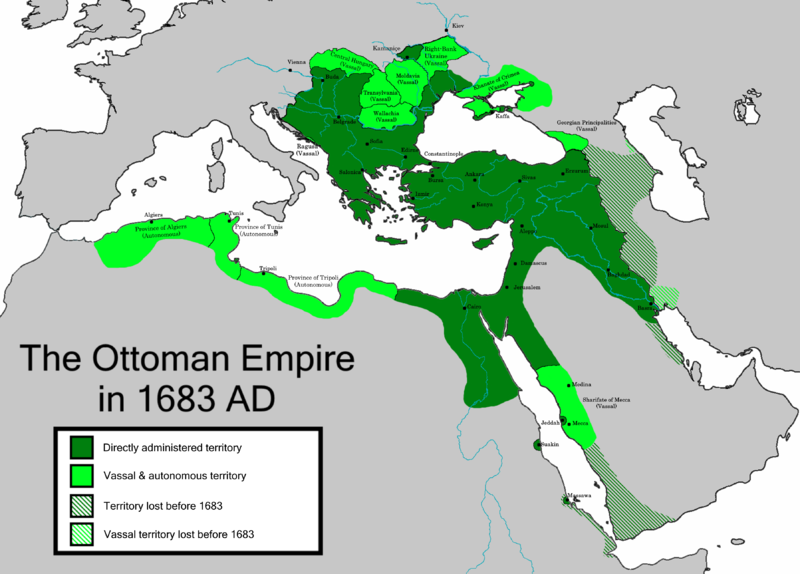
Much like in the Byzantine days, the Ottoman world centered around Constantinople. While its prosperity was damaged by the sudden absence of European trade, especially from Western Europe as they increasingly began to focus on the colonisation of the Americas, they still benefited from their own trade with India. Even when the British began to take swathes out of India, trade continued. The British and Dutch Empire’s didn’t really care about who they traded with, Christian or not, only really that they made a profit. So take that how you will.
Eventually however, the Ottoman’s declined. While this event did not cause it, historians consider it to be a significant turning point in Ottoman history and a sign of things to come; the event being the Ottoman Siege of Vienna in 1683. Suleiman had tried once and failed. Kara Mustafa, who was said to be a Sultan obsessed with the past, did not want to fail. The importance of Vienna? I hear you ask. Essentially, Vienna was a bulwark in Europe at the time. If you could get past Vienna, all of Europe stood open to you for conquest. It had been an Ottoman dream to get into the heart of Europe for centuries. Still, thanks to last minute preparations, and the combined efforts of: Austria, parts of the Holy Roman Empire, such as Saxony and Bavaria, Habsberg Hungary and the infamous Polish-Lithuanian Commonwealth. It was said that the Winged Hussars from the Polish-Lithuanian forces of 3,000 lead the 18,000 strong cavalry into the Ottoman Jannisaries (basically infantrymen), in the largest cavalry charge in history. Mustafa would later be murdered by his own palace guard, and this would signal the decline of the Ottoman Empire.
In the late 18th and throughout the 19th Century, as the Ottoman’s really started to collapse, Russia (who saw themselves as their heirs to the Byzantines) began to look to capture land. In fact, Russia’s primary goal from around Catherine the Great – Alexander III was to reach Constantinople and reclaim the Byzantine Empire. (Isn’t it amazing how many Non-Roman countries will claim themselves as the heirs to Rome? We’ve got: the Holy Roman Empire, Tsarist Russia, and the Ottomans). The most infamous war that took place under these pretexts is of course the Crimean War. While it was a victory for the Ottomans, they were in no shape to do anything beyond this. In fact, they were so weak in comparison to the other powers that a lot of Britain’s foreign policy went to maintaining and supporting the Ottomans to maintain the oh-so-crucial balance of power.
Alliances were often known to change greatly in Europe, and the end of the 19th century was no question. The Ottomans fell out of favour with Britain (basically due to Gladstone dominating politics throughout the 1880’s, who hated the Ottomans). Throughout the early 20th century, a series of political conflicts and unrest took place – the most famous of which was the Young Turk Revolution in 1908. The Triple Entente of France, Russia and Britain was formed on one side, and by World War One, the Ottomans were allied with the Germans and Austro-Hungarians (Amazing how, only 300 years ago these two were at each others necks, yet both empires would end up fighting, and dying together. Kind of poetic). When the Allies won the war, they briefly occupied the city for a time, though left in 1923 when a peace treaty was signed. The final Sultan, Mehmed VI left in November 1922, on the British Naval Ship HMS Malaya, and would die in Italy in 1926. (Right okay tangent for a sec, isn’t it really weird how each of the ‘Romans’ first and last rulers were called the same name? We have Romulus settling Rome and Romulus Augustus as the last Western Roman Emperor, Constantine who founded Constantinople and Constantine IX who was the last Emperor, and Mehmed, who conquered the city, and Mehmed VI who was the last Sultan. I personally find that interesting. Anyway).
After World War One, another revolution took place. The Ottoman Empire, now only the size of Turkey having lost all of its previous holdings throughout the past 2 centuries, became the Turkish Republic. Before this happened however, a series of ethnic cleansing took place. While a little bit of ethnic cleansing had taken place up to and during World War One, it was not on the scale seen after. It’s here, for instance, where the famed Armenian Genocide occurred. The Young Turks were partly responsible in doing these acts, as were the old Ottomans. On the 6th of October 1923, Turkish peoples celebrated ‘Istanbul Liberation Day’. Ankara was established as the new capital, which it remains today. By 1926, the name had officially changed to Istanbul, which loosely translates to ‘Let’s lead to Polis’ from Greek. In fact, post offices would refuse to send letters if an address had ‘Constantinople’ over ‘Istanbul’ in it.
From the 1940’s onward, Istanbul became more of a metropolis as many people began to migrate there. Due in part to increased trade and some industrialisation in the area. Thus, there was lots of building activity going on and new sectors were built within and around the city, the city even expanded to the other side of the Bosporus in some places. But this building work took place at the expense of many historical buildings. Much of what the city was is now gone, buried underneath layers of concrete. The famed Hippodrome, where the Nika revolts occurred under Justinian, and the famed ‘Blues’ and ‘Greens’ (the team) would race, is gone. But there is much that still exists. The Hagia Sophia and the Blue Mosque still stand. The most is buried, as I said.
And so we reach today. Where Istanbul lies, as the biggest city in Turkey. There are many nationalist Greeks that argue that Istanbul belongs to them or at the very least turn the Hagia Sophia back into a church (as it’s currently a museum), much to the Turks annoyance. Istanbul remains a cultural and religious pilgrimage spot for many Christians, and Muslims. But like I said at the beginning, Istanbul is quite possibly the single city with the richest history of any city. Its a blend of Classical Antiquity, Medieval Christian and Early-Late Modern Muslim. It has overseen the rise and fall of some of histories most powerful Empires. It has been the throne of power for some of histories greatest men (and women – Empress Theodora was a real high class woman and I will definitely do a blog on her soon). It contains some of the most beautiful architecture to ever be produced, and unlike in Rome, they still stand – after 1,500 years, the Hagia Sophia still stands. For centuries it was the capital and center of power in the world. I think there is no doubt. Istanbul is ‘The City’. It is Histories City.
 The History Book
If all the world were one country, Istanbul would be its capital , according to napoleon and you know what he may have had a point. Have you read Istanbul- a tale of three cities? It was an incredible summation of the cities history and the urban culture within as it changed.
LikeLike
I have not, mainly due to its length and my lack of spare time at the minute, but its on the reading list (albeit very far down).
LikeLike
Honestly, this is such a great article and I particularly enjoyed reading about the significance of the city during the peloponnesian wars. You mentioned that you would write a post on the fall of Constantinople and I, for one, would be extremely interested to read that. This really was a good article, I can tell you put a lot of work into it and it truly gives a great taste of Instanbul’s history.
LikeLike
Thank you! I personally find Istanbul’s history really interesting, and once I have read up on the Fall of Constantinople to a level where I can write about it without having to copy swathes of Wikipedia, I shall! 🙂
LikeLike