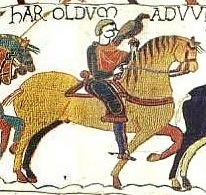
One of the most powerful names of the 11th Century, Godwin, Earl of Wessex, is a figure who remains shrouded in mystery. He came from a relatively bleak background, and played the political game to such a legendary extent that he won the greatest Earldom in England, and became the right hand man to not just one, but four kings. Godwin was a man with a dream – to found a Dynasty worthy of the titles he had won, and to have the name Godwinson remembered throughout history. Sure enough; he achieved this, producing six sons, the most famous of whom became Harold Godwinson, King of England, and is remembered even today as a paragon of Saxon virtues.
I have decided to put my obsession with this family to some good use, and form biographies of its members. Godwin I intend to discuss more separately, but his sons I feel deserve to be grouped together into a series. For Sweyn, Harold and Tostig, I shall give each their own post due to the vast amount there is to tell of them. For Gyrth, Leofwine and Wulfnoth, I shall merge into one post due to Gyrth and Leofwine living effectively the same lives, and Wulfnoth being little more than a foil character in the Godwinson narrative. I shall also write a post for Edith, the daughter of Godwin, whose remarkable character rivals and in many ways exceeds the brilliances of her brothers. Here, though, I shall discuss the Dynasty as a whole and its nature.
Godwin, as I have mentioned, came from obscurity. General assumption tends towards him as being the son of Wulfnoth Cild, a minor Saxon nobleman who had a brief period of life as a pirate. This left Wulfnoth’s land confiscated, and upon the death of its new owner, was granted to Godwin. This was the estate of Compton, Sussex.
The years of Godwin’s adolescence were ones that would forever rock England. The Danish King Sweyn Forkbeard landed on English soil with a force with which he planned to conquer England – and he did – although his untimely death through illness shortly after threw England once more into anarchy. His son Cnut, later called the Great, returned to what was now his kingdom, Denmark, where he used his characteristic blend of cunning and charm to build up a strong army from those who had previously been loyal to his father, and more besides. This included Thorkell the Tall, a former rival of Sweyn Forkbeard’s, who himself led a great mercenary army called the Jomsvikings.
The king Sweyn had displaced was a man called Aethelred the Unready. Unready is a spelling error – he was originally called the Unraed, meaning ill-counselled – although Unready was even more apt. Aethelred, agreed by most historians to be a failure of a king, died early into Cnut’s conquest, leaving his eldest son Edmund Ironside to become king in his wake. Edmund was a military hero, and he and Cnut agreed to split England and rule separate halves as equals, maintaining cordial relations. As his father and Cnut’s father had done – Edmund too met his match in the form of illness, and died before the partition could be enacted. Cnut was King of England.
Now – he needed men to help him rule it. Tradition meant that the King of England was also the ruler of its richest, most devoutly Anglo-Saxon region – Wessex. Cnut, remember, was a Dane, and he also had a Kingdom in Denmark to look after. Being Earl of Wessex was an extra job he did not need on top of King twice over. On top of this, in true Saxon stubbornness, Wessex was hardly prepared to be ruled by a foreigner, especially a Dane, and so Cnut turned to a middle ground.
Godwin, I personally believe, was himself half-Dane through his mother. There is no factual evidence to support this, but his immediate prevalence under a Danish court seems suspicious for a Saxon with no history. His father was a pirate – at the time something reserved for Danish vikings – and since 865 Danish settlers had made England their home, including areas like Sussex, so Wulfnoth could have quite easily found a Dane to marry. Regardless, Godwin had at some point during Cnut’s conquest become the King’s most trusted counsellor, and by 1020 at the latest he had become the Earl of Wessex.
He would then extend his political network, marrying Gytha, the sister of Cnut’s brother-in-law. Gytha herself was high in Danish society and very much a worthy match. Together, they had six sons and at least one daughter – many historians assume there were more daughters, although they’re obscured by history. Of these sons, the eldest three would all be given Danish names, and the younger three Saxon names. This also implies the strength of Godwin’s ties to Denmark, and makes it even more likely he had a history there more than just through his wife.
Godwin’s life from here would be one of cultivating his most valued thing; his legacy. After Cnut’s death, his favourite for successor was an unpopular choice to the other power-brokers of England, and so he switched sides, convincing the new king, Harold Harefoot, of his loyalty by gruesomely killing Alfred Aetheling, a rival claimant. After the death of Harold, Godwinson was the man who brought Harthacnut to England to be king next. Harthacnut was weak, and was a puppet king through which his mother, Emma of Normandy, and Godwin effectively ruled. Once Harthacnut was finished, Alfred Aetheling’s brother, Edward the Confessor, took up the throne. As with his predecessor, Edward had little real power, and didn’t have a firm grip on the Throne until in 1053 when Godwin died suddenly an Easter feast. The story goes that he promised Edward, “if I killed your brother, then may God strike me dead,” after which he promptly was struck dead, argued by some through choking on his food. However this is likely propagandist nonsense and Godwin simply died of a stroke. The man, after all, was rather old and had lived a life of turmoil.
The years before Godwin’s death, however, had been a huge blow to the family. Godwin and his entire family had been exiled from England after a fight broke out between them and Edward’s Norman advisers, who Godwin felt were too close to the king for his comfort. In exile, Godwin and three of his children travelled to Flanders, a hub for exiles, criminals and mercenaries, and then in 1052, after a few raids on the Isle of Wight, Godwin met his sons Harold and Leofwine at the mouth of the River Thames, and demanded their return granted by Edward. With them came the Anglo-Danes of Harold’s earldom of East Anglia, and Godwin’s loyalists in Wessex. The family were well liked among the people, whereas the Norman advisers were not. Edward exiled the Normans, and reinstalled Godwin and his children to all the land they had previously had.
By his death, Godwin had left a huge power vacuum – but he had not left it without someone to fill it. His first son had died in exile, however he had never been the magnate Godwin wanted as heir. His second and third sons, however, Harold and Tostig, fitted the bill perfectly. Harold succeeded him to Wessex, and only a few short years later Tostig ascended to Earl of Northumbria, the second most powerful earldom in the country.
By this time, there was only one other family left in England with any power. Cnut had given Mercia to an elderly yet cunning minor noble called Leofwine – a Saxon. He had died within three years and was succeeded by Leofric, husband to the folk hero Lady Godiva. Leofric was Godwin’s generation, and his son Aelfgar was Harold’s greatest rival. Both were hungry to appease great fathers, and both were powerful and popular enough to do it. However, Aelfgar was alone in his search for power, while Harold had a great family to fall back on, and so Aelfgar never achieved the dominance of the Godwinsons.
And so, when I return to this topic, I shall be glossing over less, and focusing on Sweyn, Earl of Hereford. A man who was determined to rebel against his father, Sweyn had no interest in the political game he had been born to play – and instead wanted glory of a much more heroic nature. Sweyn wanted to be a viking.
 The History Book