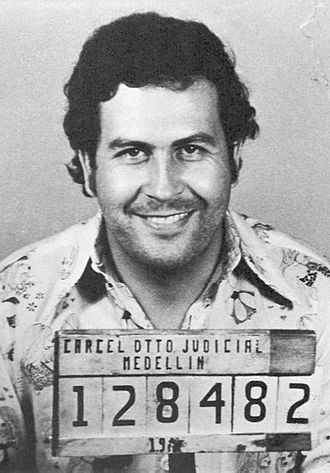
Pablo Escobar was born in rural Colombia at a time of political upheaval. Guerrilla armies and dirty politicians battled for control of the South American country; the nation set against itself in a vicious civil war. Pablo learned from a young age how easily fear could be used as a substitute for government. His father, politically active and an ally of the Liberals, narrowly escaped death time and time again against the so-called ‘Guerrillas of Peace’, but many of his friends were not so lucky, and were brutally murdered and made an example of around the town, their families killed with them. Fearing for his children’s lives, Pablo’s father sent them to their nearby city, Medellin, to live with their grandparents. It was there that Pablo’s career would begin, and his name would become one of the most notorious in history.
Pablo got involved in crime as a teenager. This was fairly typical for an impoverished youth in the slums of Medellin at the time, and Pablo balanced the fine line between legal and illegal right from the beginning. He applied to university, did courses in accounting, and attempted to set up several legitimate businesses throughout his late teens and early twenties. However all the while, he involved himself in selling illegal contraband. Some popular myths claim that he began his career by stealing gravestones, sanding away the inscriptions, and reselling them as new. His own son claims Pablo’s first racket was selling forgeries of high school diplomas. Things escalated when Pablo was introduced to big-time gangsters by his older cousin Gustavo Gaviria, and his interest in legitimate business was instantly quelled. Acting as a bodyguard and a transporter for contraband, carrying illegal goods from Medellin into nearby countries. He won the favour of all his bosses, and was given his own independent trucks and contraband routes as a reward. By the time he was twenty six, he had amassed more than 100,000,000 Colombian dollars, equal to about 3,000,000 USD. Together with Gustavo, the cousins began becoming more and more confident with routes, and coming up with cleverer and subtler techniques to transport more product across border checks, such as filling car tyres or using sewn-up potato sacks hidden underneath genuine potatoes. It was at this point that Gustavo discovered cocaine.
Still a fairly new drug on the streets, cocaine was quickly becoming a very fruitful trade within South America. People bought it, tried it, liked it, and became hooked on it. Then they’d introduce more people to it, and the process would repeat. Narcotics are the venture capitalist dream – supply that produces its own demand. Gustavo immediately took it to Escobar, who was the business-brain behind their enterprise. Escobar was convinced, and set about importing cocaine paste from Peru under the disguise of potatoes (Peru’s biggest export to Colombia). It was then baked and turned into powder within Medellin, and Escobar’s men would transport it.
Escobar was hardly the first to take up cocaine trafficking, but he was the first to make it big. His brain for business meant he could find opportunities everywhere, and with Gustavo’s management skills and his brother, Roberto’s, creative methods of transportation, he managed to make cocaine trafficking easy en masse. And he took it to the one place every businessman dreams of selling his wares – the USA.
Pablo had built up a fairly powerful business that was sustainable purely off the back of his management. The three heads of the company were him, his cousin, and his brother. Within such reliable and masterful co-commanders, the Escobar family business was immune to any internal infighting.
However, to take things to the next level, Pablo had to leave the family unit. To infiltrate the US, Pablo recruited a man called Carlos Lehder, a notoriously pro-fascist transporter, whose planes allowed Pablo to transport kilograms on thus-far unheard of levels into Miami, Florida. A friend of Pablo’s known as ‘the Champion’ also got involved, igniting a transport route from Medellin to New York. Pablo’s business had gone international.
With routes secured and being watched over by reliable lieutenants, Pablo turned his eyes inwards. In Medellin there were a concerning number of competitive narcotics magnates, most notably the Ochoa Brothers, who had been schoolfriends of Pablo and Roberto from the same neighbourhood, and José Gonzalo Rodríguez Gacha – ‘the Mexican’. Pablo realised his business would never be stable if he had competition in his home town. With Lehder acting as his diplomat, he formed the infamous Medellin Cartel. The Cartel incorporated Pablo Escobar (and by nature Roberto and Gustavo), the Ochoas and Gacha as equal partners, who would all agree on a set retail price for cocaine so as not to destabilise the market, nor undermine the others’ rackets. Thus, the most infamous gang in world history was begun.
At its height, the Medellin Cartel was shipping more than $70,000,000 (USD) a day. To give you an idea of this wealth- there was so much money that every year 10% of their savings was written off on account of it having rotted or been eaten by rats. One famous story goes that while on the run from the government, Pablo didn’t have the means to start a fire, so he burnt $10,000,000 in banknotes so to keep his daughter warm. Medellin controlled 80% of the world’s cocaine. Everything seemed undefeatable.
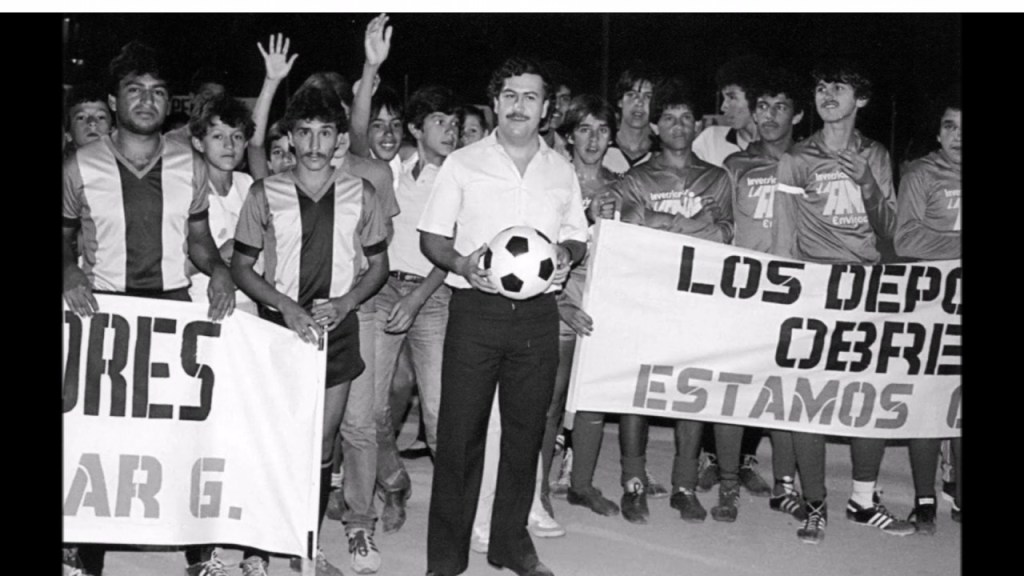
Alas, what goes up must come down. Under increasing pressure from the US Government, Escobar was put under more and more scrutiny by the Colombian police, and found running his business harder and harder. Escobar’s rackets were bringing more and more unwanted attention on the cocaine market, and this did not sit well with other smaller drug dealers – specifically, the Cali Cartel, Colombia’s second largest drug racket. They even formed a group – Los Pepes – whose sole goal was the execution of every single one of Escobar’s lieutenants.
Escobar was finally killed in 1993, on a rooftop in Medellin. At this point, Gustavo and Gacha had been killed, Roberto arrested, the Ochoas having reached a peace deal with the Colombian Government, and Escobar’s driver, Limon, was his soul remaining confidant. But such a conclusion was inevitable – Escobar had put himself against the entire world, allied himself with Communist guerrillas, made a mockery of both the Colombian and US Governments, and made enemies of his own people. What is important is not that he was ultimately defeated- but how much he achieved before that. Escobar had been born to a poor, rural family with nothing to his name. Yet he died one of the richest men in the world, and remains even today as a hero to many. He gave a voice to the poor, and funded initiatives across Colombia to help the poor. He attempted to enter politics, with dreams of becoming president and bringing an end to wealth disparity, but was forced out. He insisted all his life that he was only forced out because he was an honest politician.
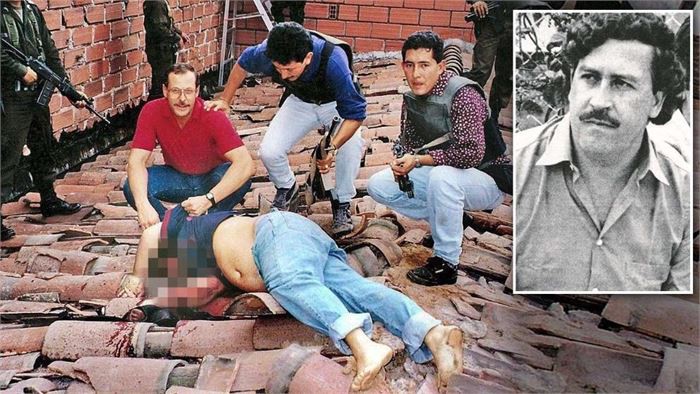
In Medellin, Escobar is still remembered as a hero for his charity work, his role in the narcotics industry overlooked for his overall altruism. He has also ignited worldwide interest in the country, and sparked a major tourism boost to his home city. His brother Roberto, and his son (who has since changed his family name), continue to press Pablo’s charitable side, and many of his surviving men have gone straight. Popeye, his head hitman who claims involvement in as many as 3,000 killings and personally committing over 300 (including that of his own girlfriend), went on to become a youtuber following his release from prison in 2014 – although he has since recently died after a long battle with cancer.
Escobar is a one-of-a-kind historical figure. As famous now as the day he died, he has left a legacy of brutal warring factionalism, drug addiction and merciless killing, as well as a legacy of altruism, charity work and capitalist success. Whatever one considers their own idea of Escobar – hero or villain – everyone can nonetheless agree he spent many years ruling as Colombia’s King, and a crown as powerful as his likely shall never be seen again.
 The History Book