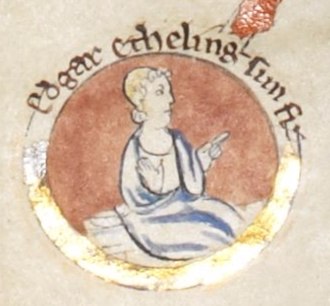
We all know William the Conqueror, the Norman King of England. We all know Harold Godwinson, the English magnate who took power in 1066 and lost to William at Hastings. Most of us also know Harald Hardrada, the ‘last Viking king’ who died at Stamford Bridge attempting to conquer England. However, there is one other key claimant to the English throne whose claim was – although it has been written off by historians for centuries – in many respects the only valid claim. This man, or rather, boy, was Edgar Aetheling.
Edgar was born in Hungary to Edward the Exile, the son of Edmund Ironside, the king of England for a brief period in 1016. Ironside was the eldest son of Aethelred the Unready, who was deposed by Sweyn Forkbeard, the viking king of Denmark. Aethelred had managed to regain the throne just in time for his own death, and Edmund had inherited the throne just in time for Sweyn’s son Cnut ‘the Great’s conquest of England. One popular story goes that Edmund died while going to the loo. Toilets in 11th Century England weren’t quite what they are today – so this particular toilet was just a large pit outside his tent. Inside this pit hid an agent of Cnut’s, who drew out a spear and thrust it into Edmund’s behind, killing him. This tale is likely not true, but it does make quite a good story.
Anyway, in lieu of Edmund’s death, his wife and children were exiled, first to Sweden then to Kiev, then finally to Hungary. In Hungary, Edmund’s younger son died, but Edward the Exile flourished. He had married a princess in Kiev, and won himself political clout as a member of the King of Hungary’s retinue. He was happy there. However fate did not have a happy life in mind for Edward.
Let’s return to England. Since 1042, the king has been Edward the Confessor. Edward the Confessor is the youngest son of Aethelred the Unready, and thus Edward the Exile’s uncle. (Two Edwards, I know, I’ll make sure I always specify which). Now a side note – Aethelred the Unready was a member of the dynasty sometimes called the House of Cerdic. This dynasty had ruled Wessex for centuries, and England as a whole since the early 920s. It was the only surviving royal Anglo-Saxon house, and its name carried a weight like none other in Northern Europe at the time. Now that Edward the Confessor sat on the throne, there were two surviving heirs through the paternal line, and therefore only two true members of a dynasty that had dominated English politics for centuries. Those, of course, were Edward the Confessor, and his nephew, Edward the Exile. And because of this, in 1056 the Confessor sent an embassy to Hungary to recall the Exile, with his wife and four year old son, to England so that he could be named heir. Edward the Confessor was reportedly celibate, and had no kids of his own. All hopes of a continuation in the royal family hung on Edward the Exile.
Alas, Destiny has a sick sense of humour. Within days of landing in 1057, before Edward the Confessor got an opportunity to meet his distant nephew, Edward the Exile died. (Phew, back to one Edward). Suddenly, the situation had changed.
Without Edward the Exile, his son Edgar Aetheling became the sole hope for King Edward’s succession. Had Edward had the wonderful hindsight we as historians have, perhaps he may have put more attention into his great-nephew. But he was a fairly ineffective, sometimes foolish, king, and as such, he proceeded to spend the final nine years of his own life neglecting his son. In that time, Harold Godwinson emerged as the most powerful magnate in the kingdom, William of Normandy secured a military powerful enough to make any dubious claim appear valid, and Harald Hardrada had himself manipulated by Harold Godwinson’s jealous younger brother into launching the first Viking invasion since Cnut’s.
As such, when Edward did as all kings do, and died at the least convenient time he could, there was an immediate grapple for power. With his friends and clients in very high places – his brothers were earls and one of his closest friends was the Archbishop of Canterbury – Harold Godwinson emerged confidently as king. However that’s not to say there weren’t other powers at work. Edwin and Morcar, the sole earls in England who didn’t owe Harold any allegiance, offered their support to Edgar, who let’s not forget is only fourteen at this moment in time. And thanks to Edward’s neglect, Edgar had no military nor land to rely on to press his claim. Knowing when to cut his losses, Edgar presumably let out one big sigh, and supported Harold. Ten months later, after Harold’s defeat at Hastings, Edgar was again offered the support of Edwin and Morcar, but once more he declined, seeing that William really was someone you wanted to be on the right side of.
William was more than content to let Edgar live out a peaceful life in England, but Edwin and Morcar had other ideas. A rebellion in 1068 once more declared him the true king, but at this point in time Edgar was too busy failing to return to his birthplace of Hungary to really care about the politics of England. Eventually he settled in Scotland, with the politically masterful King Malcolm as his lord. However, Malcolm was only so willing to stick his neck out for the exiled prince, and when William threatened invasion and demanded Edgar’s expulsion from the British Isles, Malcolm knew where to hedge his bets.
Edgar, once more a political nomad, he settled in Flanders, which was famously anti-Norman. There, he was approached by an ambassador from France who offered him on behalf of the king a castle near Normandy, from where he could raid William’s lands freely and avenge his lost kingdom. Edgar was no doubt thrilled by this opportunity, but while sailing to France his ship was wrecked on the coast of England, and most of his men mercilessly tracked down and killed.
However, once more, Edgar found himself fleeing to Scotland. There, he convinced
Malcolm to negotiate his peaceful return to England as William’s subject. William conceded, now safe enough in his rule to run the risk of Edgar returning home, and let him return to England.
William, though, failed to shower Edgar in the wealth and glory he wanted, and feeling once again disaffected, Edgar decided to take one massive gap year. To Italy. In 1086, aged 34, Edgar fled England. He renounced his loyalty to William, and settled in Norman Puglia. However, a few years later, he retreated back once more to England, where William Rufus was now king.
After William I’s death, Edgar had lent his support to his eldest son, Robert Curthose, acting as a senior advisor to the Norman prince. However, once William II, the second son, put Robert in his place, Edgar found himself suddenly out of a job. Edgar then began flitting between England and Scotland, where he played political chess with Malcolm’s successors, determined to maintain his own influence in the Scottish court, until a sudden spark was lit across Europe – the first Crusade.
Edgar travelled to the Holy Land with the crusader as one of the commanders of the English ships. Following his brief stint as a Crusader, Edgar likely enrolled in the Varangian Guard, the elite mercenary army of the Byzantine Empire, and was offered a place at both the Byzantine and Holy Roman Empire’s courts, however he declined both, and travelled back to Normandy. There, William’s eldest son Robert Curthose again needed a senior adviser, since he was battling Henry I, England’s latest king. Edgar took up this role, and again failed miserably. Robert was imprisoned for the rest of his life, but Edgar escaped such a fate. He returned to England, where he took up a home in the countryside, and retired to a peaceful life. There, he spent his final years avoiding English dynastic politics, and died peacefully. And with him, since he likely had no sons, died the House of Cerdic. The death of Edgar was, it seems, the final nail in the coffin for Anglo-Saxon England.
 The History Book