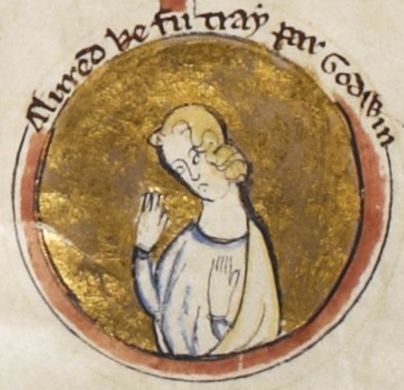
Alfred Aetheling was the youngest son of Aethelred, and one of only two to survive the conquest of King Cnut – Britain’s first Viking King. His older brother, Edward, would later become Edward the Confessor, a name we are all familiar with.
King Cnut broke the rule of the Line of Cerdic, a dynasty of Kings who had singlehandedly formed England from a mess of kingdoms and tribes. Cnut, a peaceful and intelligent ruler, rewrote the identity of England. Since the Great Heathen Army of the late ninth century, Scandinavian settlers had come to England in hordes seeking better, more fruitful land to farm, and these people had been neglected entirely by the Anglo-Saxon nobility, and left to their own devices. Cnut turned England into a refreshed, Anglo-Danish state united under a secure ruler.
Unfortunately, all good things come to an end, and an old and ill Cnut died peacefully, but that was the only peaceful part of the tale.
Cnut died with two sons, from two different mothers. One, Harold Harefoot, was favoured by the Anglo-Danes, while the other, Harthacnut, was favoured by the still very Anglo-Saxon region of Wessex. This was due to the fact Harthacnut’s mother was Emma of Normandy, who was also mother to Edward and Alfred. As such, in many ways, Harthacnut was very nearly an Anglo Saxon.
However, it was Harold Harefoot who took the throne. Emma of Normandy and Earl Godwin opposed this choice outright, marking their support for Harthacnut – but he was in Denmark securing his throne there. As such, a spiteful Emma sent word to her other two sons, by Aethelred – the Anglo-Norman Edward and Alfred. Together, the pair gathered retinues, sponsored by their uncle, the Duke of Normandy, and set sail for England.
Typically of brothers, both took different routes, believing in different ways of taking the throne – remember, they were most likely both after the Crown. Edward landed in Southampton, where he found a public who hated the idea of a return to the oppressive and elitist aristocracy Aethelred had installed and Cnut had destroyed. They would never accept this young man as king while Cnut still had living sons – Edward returned to Normandy immediately.
Alfred however was younger, more brash, and much more determined. Earl Godwin, a supporter of Emma of Normandy and Harthacnut, invited him to stay at his estate. Alfred took Godwin’s support for Harthacnut as support for him too, by default, and arrived at the estate feeling confident.
There, his men were captured. My favourite chronicler, Henry of Huntingdon, later wrote in the early twelfth century that: “so the Normans were captured and bound, and when they were sitting in ranks at Guildford, nine out of every ten were beheaded, and only the one tenth survived. But when they had all been killed , except one out of every ten, it seemed to the English that there were too many survivors, and they had the tenth decimated, and so only a very few escaped.”
This gruesome annihilation of men stained Godwin’s reputation forever, and although Henry of Huntingdon is notorious for his looseness with accuracy in favour of a good story, this version of the execution is supported by other more reliable sources, like the amazing Anglo-Saxon Chronicle. However, Godwin’s reputation would be stained yet further.
Alfred himself, while he slept, unaware of the chaos around him, was grabbed from his bed. Bound to a horse, he was bungled into a boat, which made its way towards the monastery at Ely. There, his eyes were gouged out with knives. This was used in many places in Europe in the late medieval era as a way of subduing opponents so that they were unable to conspire or fight against you without the need to take their life, and so it’s agreed that the aim was not for Alfred to be killed. However, the violence with which Alfred had been attacked was so vicious and brutal that his wounds were fatal, and in the monastery, under the care of monks, he died painfully and dishonourably.
It was in this way Godwin showed his allegiance to the new King, and prevented him from being an enemy of Crown and country, and the folk story – which is almost certainly made up – says that at an Easter feast in 1053, Godwin told King Edward that “if I killed, or played a part in the killing, of your brother, then may god strike me down dead”. God did, and in that instant, Godwin choked on a morsel, collapsed and died.
 The History Book