In an earlier post I discussed the formation of the First Triumvirate and its characters: Caesar, Pompey, and Crassus. This post is going to gloss over the origins, so I recommend reading that if you aren’t already aware of the politics of the Late Republic. This post will focus in one of the antiheroes of the Triumvirate – Marcus Licinius Crassus.
Crassus, Rome’s political spider, had spent his career building a web of networks in the heart of Roman politics. Not born a Patrician, Crassus had been born into the fairly new trade of administering finances of the Roman colonies, and at this he was an expert. He was at the time the richest man in Rome, and as such, arguably the whole civilised world. As he belonged to this class – known as Equestrians, or the Equites – his political links were much more scarce than those of his Patrician contemporaries – men like Pompey and Caesar.
Crassus truly came to prominence during the dictatorship of Sulla – who likely one of us will write about in the future. His father, an ex-consul, had allied himself with the losing side, and committed suicide causing a young Crassus to flee to Spain. Already gifted in the arts of political maneuvering, he promptly declared his support for his father’s enemy – the General, Consul and later Dictator Sulla. Sulla is perhaps most famous for his proscription lists. These were literal lists, left in the Forum naming men he deemed a threat as enemies of the Republic. As such, they could be killed, and their killers would promptly receive rewards for their contribution to Sulla’s regime.
The moment a name was added to the list, their property and wealth in Rome was considered up for grabs – and for Crassus, this was a moneymaker. Crassus now had wealth and a powerful ally. Now he wanted what every Roman dreamed of – military glory. After he and General Pompey the Great ended the Spartacus rebellion, however, Crassus had become in the eyes of his soldiers a man to fear, on account of his vicious treatment of not only his enemies but of his own men, while his rival Pompey had become a man to love. This Machiavellian conflict of love and fear left both men at each other’s throats for the rest of their lives.
This rivalry pursued in the time of the Triumvirate, where the two fostered the younger populist politician Julius Caesar, whose reputation and influence quickly began to rival Pompey’s. After a consulship in 59BC, Caesar took place in Gaul, where he as governor ignited a very illegal war against the Germanic tribes – collectively the Gauls. This left two men in effectively complete control of Rome – the age old rivals Crassus and Pompey. After their second shared consulships, the two took up their own governorships, Pompey to Spain and Crassus to Syria.
So now of the three triumvirs, you have Pompey, whose military ability has doubled the size of the Republic; Caesar, who has singlehandedly dominated a foreign land where Romans previously had feared to tread; and Crassus, whose only military successes were minor and alongside Pompey. Naturally, when Crassus went to Syria, he went there looking for a fight.
At first, Crassus was enormously successful, and he ravaged Syria ruthlessly through his unique ability for extortion and tax collecting. However debt collectors rarely make legendary heroes, and so with his son Publius, Crassus crossed the Euphrates into Parthia in 53BC. There wouldn’t be such an embarrassing moment for Rome for many more years.
Crassus had been offered support by the Armenian king, so long as he invaded through Armenia, and gave the kingdom some land in its wake, but Crassus had won victories alongside men before, and been snubbed because of it. This was him, his son, and his own seven legions. He invaded through Syria, and Armenia shrugged their shoulders, and did not lend their support.
Crassus walked straight into Parthia, expecting an army over every hill. He found some skirmishes, some resisting villagers, but no great army, like Parthia boasted. He figured this was an easy war, and continued forwards. It was at this point he heard word of a great army approaching.
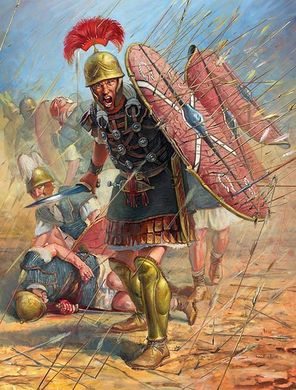
At this, Crassus went against the advice of his generals, and ordered his men to make a hollow square. This technique was one of the favoured ones of the Roman army, but the better decision would’ve been the other suggestion – a line with the infantry spread out wide and the cavalry on their flanks. This would’ve left the two armies on equal footing – although Crassus would’ve had five times the men. However, in a square, the Romans invited the opportunity to be surrounded. The Parthian army, 10,000 cavalrymen strong, quickly did the obvious, and began shooting arrows into the square. The Hollow Square was famously impenetrable, with the large shields deflecting blow after blow. However it was impossible to continue this forever.
Publius eventually convinced his father to let him use his personal Gallic cavalry of 1,300 men to scare away the archers on the northern front, and open the battle into two lines as originally suggested. As Publius left the square, the Parthians feigned retreat, and once Publius had chased them that little bit too far, the Parthians encircled them just as they had the square. However, Publius men weren’t able to defend themselves with shields. Crassus, assuming the best, followed the path of Publius’ horsemen, where he was met with the head of his son, impaled on a spike.
The Romans now fled, and maintained their square as they spent an entire night crossing the desert plain to the town of Carrhae. In this retreat, 4,00 injured men were left to die. The Parthians took their time following, killing all of these injured and dying men one by one.
At Carrhae, the Parthians offered to organise a truce – after all, Crassus still outnumbered them threefold at this point. After being threatened with mutiny, Crassus did so. The Parthians, aware of Rome’s loss of hope, massacred Crassus and the generals then and there. The Roman army did not respond.
After all of this, Crassus had lost seven whole legions, and all of his conquered lands. 20,000 men died, and a further 10,000 captured and sold into slavery. Crassus’ head was used as a prop in a play, and his battle standards stolen. His legacy was finally achieved – not as a name among Pompey the Great, but as Rome’s Shame. The General who lost Seven Legions.
 The History Book