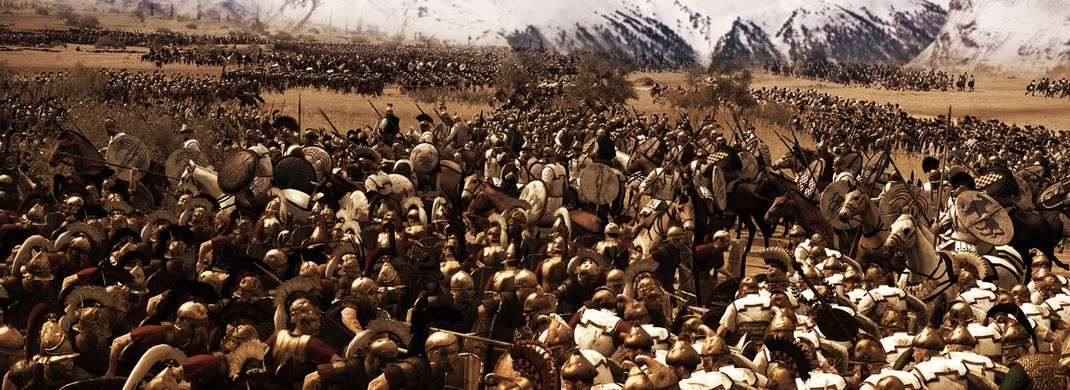
The Battle of Cannae, which occurred on the Second of August 216bc, is one of the most defining moments of Military History. It was a battle that saw the Roman Republic attempt to destroy Hannibal Barca’s armies. Hannibal’s tactics in this battle are still taught in military academies today, over 2,000 years later. This is the battle where Hannibal would prove his genius, putting himself up there with the likes of Alexander the Great. This is the battle that would lead to his name running a shudder down the spines of every Roman until the fall of Constantinople.
Following Hannibal’s Victories at the Trebia River and Lake Trasimene, the Romans had essentially had enough. Most Senators were glory hungry and the patricians did not appreciate the strategies of Quintus Fabius Maximus (Which essentially amounted to keeping an eye on Hannibal as he moved his way through Italy, but never directly engaging him). Under the newly appointed Consuls Marcus Terentius Varro and Lucius Aemilius Paullus, the Republic amassed the largest army they’d ever produced and sent it South to where Hannibal was.
Paullus, as described by Polybius and Livy, was the more experienced General, being between 50 and 60 years old with a distinguished career and receiving a Triumph in 219. He was a member if the Aemilii Clan – one of the oldest and most prestigious families in Rome. It was said they even traced their lineage to Romulus himself.
Varro meanwhile was an upstart. He was often looked down upon for his humble beginnings, having been born a plebeian but risen through the military ranks. He was outspoken against the senate. Modern Historians now think that the blame put on Varro at this battle is somewhat undeserved, due to Historians like Livy being biased towards the old patrician families. Livy calls him arrogant and impatient, who was desperate for a Military Triumph to prove his worth. Polybias called him a disgrace. Varro was elected via popular assembly and it was said the relationship between the two consuls was one more of Gladiators than colleagues.

They found Hannibal just outside of a small town called Cannae in southern Italy. The grain storage’s there had been taken by the Carthaginian. He’d placed himself next to the Aufidus River. Opposite the River, and behind Hannibal were mountains this squeezed any engagement to a maximum length of one mile wide. The Romans believed him to be trapped. They blocked the only exit.
Paullus, who was in charge of the troops the day they arrived (because when two Consuls were together, they took it in turns on who was leading the troops that day), sensed a trap. He warned against engaging with Hannibal. The Roman troops themselves were mostly recruits, due to Hannibal killing most veterans at their other engagements. Yet Infantry still outnumbered Hannibal 2-1. The Romans had 80,000 men and 6,000 cavalry. Hannibal had 40,000 infantry, with 10,000 Cavalry, especially the deadly Numidian Cavalry (Who were the best Cavalry in the world at the time). So the story goes, Varro was confident of victory.
The Romans split their camp (as shown above) across the river, with the much larger force on the Southeast bank. Hannibal then moved his camp to the southeast bank too, and sent his Numidian Cavalry to disrupt Romans collecting water. In the middle of a Mediterranean summer, this could prove disastrous for an army before a major battle. Yet Varro remained confident, as on August 2nd 216bc, he made the fateful decision and chose to fight.
The Romans organised themselves into the traditional Roman Phalanx for the time. Leaving a single legion back to guard the camp, they brought the rest of the army to the field. Both flanks were made up of cavalry, with the right flank by the river facing south. The infantry lined up, taking up the entire 1 mile wide pass. Their battle strategy was to not allow the Carthaginians to outflank them, as they were covered by the mountains and river. This likely could have worked, so long as the infantry worked as a single unit and the cavalry was not chased off the field. Varro headed the cavalry on the left, and Paullus on the right. Servilius Geminus commanded the infantry.
Hannibal meanwhile brought his entire army to the field. Hannibal was outnumbered by at least 20,000 infantry. Still, he lined up and faced north, with the wind from the Mediterranean blowing at the Carthaginian’s backs (and into the Romans faces). He lined his Spanish and Celtic cavalry on the left, facing Varro under the command of his brother, Hasdrubal and the Numidian cavalry on the Right, facing Paullus under the command of Maharbal. He then did something incredibly interesting. He lined up his infantry into an inverted crescent, and made the line incredibly thin to match the Roman’s. In the middle, he put his Celt and Spanish infantry(Much of the Spanish were wearing Roman gear, stolen from Trebia and Trasimene), and either side of them he put his much better African infantry (He put these troops slightly behind the line, so the Romans would not see them). During the entire time the troops were lining up, Hannibal ordered his troops to shuffle their feet. Being the middle of summer, the ground they were on was very dusty. By shuffling their feet, the Carthaginians would bring dust up into the air, which would then be carried on the northerly wind into the faces of the Romans. Hannibal then, with his youngest brother Mago, put himself in the very middle of the Spanish and Celtic section, and ordered his troops forward.
The light cavalry of Hasdrubal quickly met the Roman cavalry next to the Aufidus River. It was said the battle was so tight that many dismounted and fought a bloody hand-to-hand combat. Despite Roman efforts, the Carthaginian’s were simply more experienced and executed better. Paullus was injured very early in the battle, being hit by a Slinger in the head (Slingers could hurl metal at their enemies at over 120mph). His personal guard surrounded him whilst the rest of the cavalry fled the field. Still, Paullus attempted to command the infantry, but this proved hard due to him no longer having a mount and he could barely see over the heads of that many men (And he was dying…)
The other flank was not faring much better either. The fighting had originally been a stalemate, due to the lack of space. But once Hasdrubal came around the backs of the infantry, Varro’s cavalry was routed and they fled. Varro with them.
Meanwhile, the Roman’s perceived themselves to be winning in the infantry. When the two lines met, the Romans pushed hard against the thinner line of their enemies. And they retreated, slowly and carefully. The Roman’s believing themselves to be winning, massed more troops into the center, hoping to use their sheer numbers as a battering ram to break the line. The more troops they massed in, the tighter in became however and the Traditional Phalanx basically fell apart under the sheer weight of numbers. It’s said they were so pressed together that only the outer edges were able to wield weapons. The men at the back, hungry for their moment of glory, pushed forwards. The Spanish and Celts did not break. They only kept moving back.
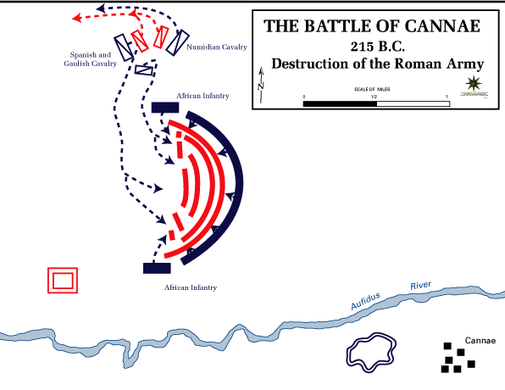
Placing himself and Mago in the center was by no means an accident. In doing so, Hannibal encouraged the Celts and Spanish to not flee. So they merely moved back. The inverted crescent began to straighten out, and then turn in on itself.
In that moment, the trap was closed. Romans suddenly saw the African units close in on their flanks, and the Cavalry close up the rear. Hannibal, in his genius had managed to trap a larger army, with a lesser one. Perhaps the Romans had never seen the African infantry, through their vision-obscuring helmets and dust. Hannibal’s central force stopped its retreat and renewed the attack. The Roman Gladius short swords were no match for the Celtic Long swords, African sabers and the deadly Spanish Falcata. The heat, lack of water and heavy Armour of the Romans now caused exhaustion, they were so tightly packed in that they could no longer move their arms. They were butchered.
Paullus bled profusely from his wounds. He was too weak to mount a horse, despite being offered one by his guard. Instead, he told his men to flee while they could and send word to defend Rome itself. Among those who fled were the aforementioned Varro, but also Publius Scipio (Scipio Africanus’ father).
By the end of the day, when the battle finally ended, 70,000 Romans were dead, to 6,000 Carthaginians. By most modern accounts, 30,000 gallons of blood were spilled in a single day. Only a single legion survived (The ones who were guarding the Camp) and they were all taken prisoner. Besides Aemilius Paullus, those dead were ,Servilus Geminus and Marcus Minucius. 29 of 48 Tribunes were killed. Eighty senators were killed. Cannae was meant to be a great victory, the final defeat of Romes’ greatest enemy, which is why so many high ranking men joined the force. Instead, it turned into a massacre. Rome’s military leadership was decimated.
Its estimated that 20% of all Romans between the ages of eighteen and fifty died at Cannae that day. The stench must have been awful. It was said that many of the mortally wounded Romans dug their heads into the dirt to suffocate themselves and end their suffering. Who knows how long it took Hannibal to bury the dead, or how long it took to gather up all the rings of the eques (of which he sent back to Carthage as proof of his victory and spoils of war)?
Why did Varro flee so early? Likely due to self-preservation. Polybius and Livy go to great lengths to vilify Varro and his actions at Cannae. Yet the great irony is that now, many historians believe that it was actually Aemilius Paullus in charge that day.
Following Cannae, the words “Hannibal ad portas” spread through Rome like a plague, all of them being terrified of “Hannibal at the gates”. No surprise either. Cannae remains, to this day, the battle where more soldiers died than in any other day of battle in Western History.
 The History Book